

You’ve probably seen it all over TikTok and Twitter — someone drops a wild video, and the comments are flooded with just one word: chile.
It’s short, it’s spicy, and it says everything without saying much at all. Gen Z has a gift for turning simple words into powerful reactions, and “chile” is one of their best.
But what does it actually mean, and how do you use it right? If you’ve been confused or just curious, you’re in the right place.
Keep reading to find out exactly how “chile” became one of 2026’s most viral slang words — and how you can use it like a pro.
ULTRA FEATURED SNIPPET BLOCK
What does “chile” mean in slang?
In modern internet slang, “chile” is a dramatic reaction word used to express shock, disbelief, exhaustion, or sarcasm.
It is a phonetic spelling of “child” rooted in African American Vernacular English (AAVE), where the “d” is dropped and the word is drawn expressively.
| Feature | Detail |
| Slang Word | Chile |
| Pronunciation | /CHīl/ (like “child” without the “d”) |
| Origin | AAVE (African American Vernacular English) |
| Core Meaning | Shock, disbelief, sarcasm, or dramatic reaction |
| Common Spelling Variations | chile, chileee, chileeee |
| Primary Platforms | TikTok, Instagram, Discord, Twitter/X |
| Who Uses It Most | Gen Z, Black Twitter community |
| Status in 2026 | Stable, mainstream reaction slang |
Core Meaning Explained

At its most basic level, “chile” is a stylized, expressive spelling of the word “child.” But in slang, it does not literally refer to a young person.
Instead, it functions as a one-word reaction — something you drop when you witness a situation so messy, awkward, or unbelievable that a full sentence just won’t cut it.
The slang meaning is emotional and expressive, usually deployed in response to messy or unbelievable situations.
The tone ranges from neutral to sarcastic, and it’s most commonly used by Gen Z alongside Black Twitter culture.
Think of “chile” the way you might think of “wow” or “oh my god” except it carries more theatricality, more personality, and a whole lot more cultural flavor.
The stretched spelling, “chileeee,” amplifies the emotion even further. The longer the word, the bigger the reaction.
Origin + Evolution Timeline
Early Internet Roots
“Chile” is an African American, considerably Southern way of pronouncing the word “child,” drawing the “I” and dropping the “d” ending.
It is merely a phonetic spelling of a stereotypically Black pronunciation of “child.”
Contrary to popular belief, AAVE didn’t start in the 21st century — it can be traced all the way back to slavery and has been used by Black people for centuries.
“Chile” as a spoken expression has existed in Black communities, especially in the American South, for generations.
It was used by mothers calling their children, by elders expressing disappointment, and by communities reacting to all manner of drama long before the internet existed.
It’s a word used in AAVE, usually used by mothers to refer to their children. Other people use it to refer to their younger friends or peers.
Meme Spread Phase
The word’s explosive spread online has a very specific moment attached to it. It became popular when Nicki Minaj used it on an Instagram Live.
Although she brought popularity to it, the word has been in the Black community for years.
Chile is pronounced like a child without the “d.” It’s sometimes used when someone does something questionable, sort of like “wtf.”
Nicki Minaj popularized it when someone commented on her appearance on Instagram Live and she responded with “um chile… anyways.”
That single moment sent the phrase into orbit. Screenshots went viral. TikTok users stitched reactions. The phrase “chile anyways” became a meme template practically overnight.
Later, “chile” began to be used as a put-down for the person being addressed, implying they were acting childish or foolish so its meaning is actually quite layered and complicated.
Mainstream Adoption
By the early 2020s, the word had crossed firmly into mainstream internet culture. By the early 2020s, “chile” became common in comment sections across Instagram and Twitter, with non-Black users beginning to adopt it, sometimes without understanding its cultural background.
This mainstream crossover came with legitimate cultural debate. There are even anonymous Twitter accounts dedicated to broadcasting embarrassingly misused AAVE by non-Black people, proving it’s a language with complex structures and not just a batch of fun slang words to use as you please.
2026 Current Usage
By 2026, “chile” has settled into what linguists might call “stable reaction slang.” It’s not brand-new viral. It’s not outdated either.
It functions like “bruh” — long-term digital vocabulary that will likely remain in reaction culture but may evolve in spelling or tone. Meme language rarely disappears; it mutates.
How Gen Z Uses Chile Meaning Slang Today in 2026
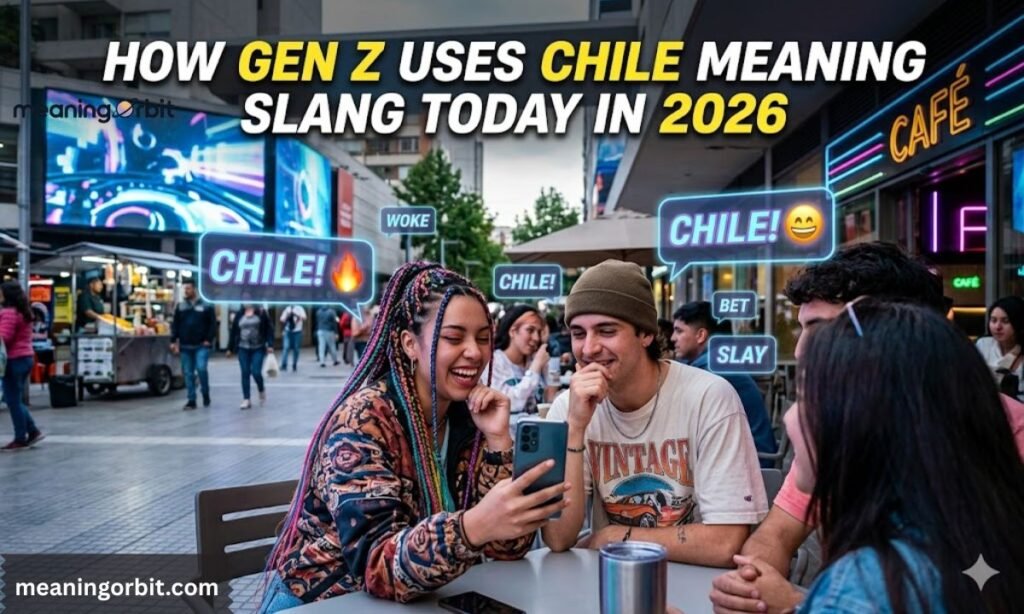
Gen Z doesn’t just use words — they perform them. Here’s how “Chile” shows up across the major digital platforms in 2026.
TikTok
TikTok remains the heartbeat of this word’s continued popularity. It appears in comment sections under messy drama videos, in story-time content, and in caption overlays on reaction clips.
A creator posts a chaotic update about a situationship? The comments are filled with “chileeeee.” Someone reveals a shocking plot twist in their day-vlog? “Chile” is the first word out of the keyboard.
Discord
In gaming and fandom Discord servers, “chile” works as a rapid-fire reaction in text channels. It replaces longer expressions of disbelief during live events, game reveals, or community drama.
When a teammate does something completely unexpected, “chile 💀” says everything without pausing the moment.
Gaming Chat
In fast-paced gaming environments, short expressive words thrive because nobody has time to type paragraphs mid-match.
“Chile” fits perfectly: it’s fast, it reads immediately as a reaction, and it doesn’t disrupt the flow of conversation.
Instagram Comments
Instagram comments are where “chile” really stretches its legs. It pairs with the side-eye emoji, the skull emoji, and the crying-laughing face as shorthand for “this is unhinged and I cannot believe what I’m witnessing.”
It often appears under messy relationship content, celebrity drama, or cringeworthy behavior.
Text Messages
In group chats and DMs, “chile” shows up the same way “omg” does; it’s a quick, emotionally loaded opener before the real reaction follows.
“Chile not him calling you at 2am after all that” is a complete, perfectly understood response in modern text communication.
Real Chat Style Examples
Seeing the word in action is the fastest way to understand it. Here are natural examples:
- TikTok comment: “Chile, she really wore that to the reunion 💀”
- Group chat: “Chileeee, they broke up AGAIN?”
- Discord: “chile why did he do that mid-tournament 😭”
- Instagram: “Chile anyways… moving on”
- Text message: “Not him texting back after three weeks. Chile please.”
- Twitter/X: “Whew chile, that ending did NOT have to hit like that”
Notice how the word replaces a full-sentence reaction. It packs drama, disbelief, and personality into a single expressive punch.
Similar Slang Comparison Section
Understanding “chile” gets easier when you line it up against the other reaction words floating around online.
| Slang Word | Core Vibe | Key Difference from “Chile” |
| Girl | Direct, conversational | More grounded; “chile” is more theatrical |
| Bruh | Frustration, disbelief | Frustration-forward; “chile” leans more toward dramatic disbelief |
| I’m weak | Something is funny | Humor-specific; “chile” works for messy, not just funny |
| Oh no | Neutral, sympathetic | Plain reaction; “chile” adds personality and cultural tone |
| Side eye | Skepticism, silent judgment | Visual energy; “chile” verbalizes that same energy |
“Girl”
“Girl” is direct and conversational when you’re speaking to someone. “Chile” is more theatrical and can stand alone as a reaction without needing an audience.
“Bruh”
“Bruh” leans heavily into frustration or mild exasperation. “Chile” shows disbelief with more flair and dramatic emphasis.
“I’m weak”
“I’m weak” signals that something is genuinely funny. “Chile” has a broader emotional range — it can react to drama, messiness, awkwardness, or comedy all at once.
“Oh no”
“Oh no” is a neutral, somewhat sympathetic reaction. “Chile” adds personality, cultural tone, and a hint of sarcasm that “oh no” simply doesn’t carry.
“Side eye”
The “side eye” is visual judgment, silent, expressive skepticism. “Chile” can verbally carry that same energy, especially when paired with an emoji.
Psychological + Social Meaning
Why do people reach for “chile” instead of just typing “wow” or “I can’t believe this”? The answer lies in how modern communication actually works.
Emotional Compression
Slang compresses emotion into one expressive word. Fast. Efficient. Dramatic. In short-form content culture, speed matters.
When someone comments “chileeee,” they’re signaling: “I see the mess too,” “I understand the drama,” and “I’m in on the joke.
“Digital communication rewards brevity. One word that says everything is infinitely more powerful than a paragraph that says the same thing.
Social Validation
When you comment “chile” on someone’s post, you’re doing more than reacting, you’re joining a community response.
You’re signaling shared understanding. It’s a communal witness in real time, expressed through a single word.
Identity Signaling
The language people use online is a form of identity expression. Using slang correctly knowing when to deploy “chile” versus “bruh” versus “bestie” — communicates that you understand the culture, the platform, and the context. In Gen Z digital spaces, linguistic fluency is social currency.
When NOT To Use This Slang
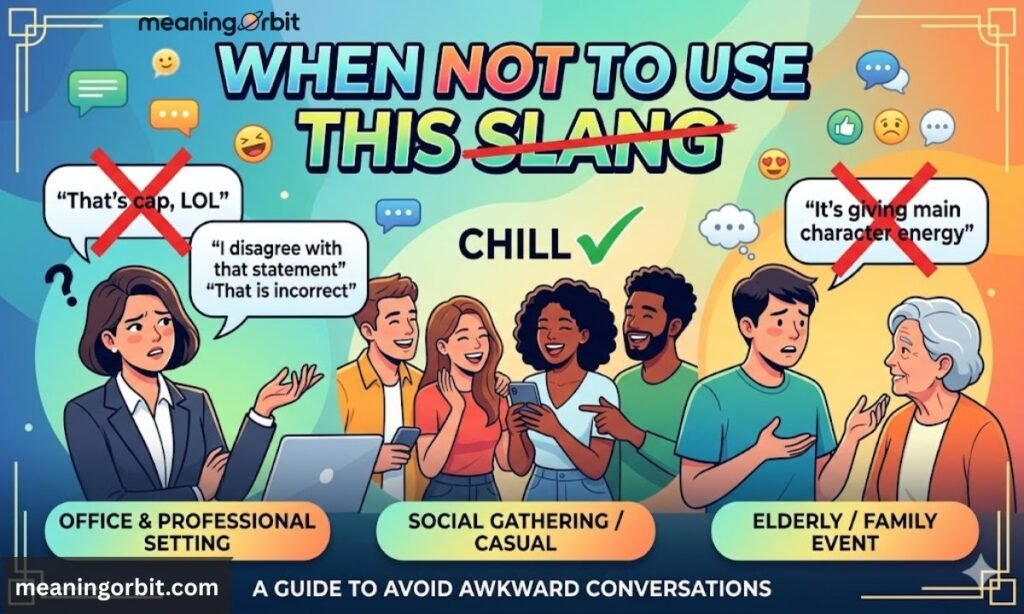
Knowing when to hold back is just as important as knowing when to use a word.
Professional Situations
Academic essays, resumes, LinkedIn posts, work emails, and formal presentations are not the place for “chile.”
Slang meaning works in informal spaces, not structured communication. Using it in a professional setting signals that you don’t know how to code-switch, which can undermine your credibility.
Older Audience
Some older users may interpret it literally as “Chile” the country or think it’s a typo. If you’re communicating with someone who isn’t plugged into internet culture, the word will create confusion rather than connection.
Formal Writing
Journalism, academic papers, official statements, and formal reports should be free of informal internet slang. “Chile” has no place in structured, institutional communication.
Is This Slang Still Trending in 2026?
Yes and here’s the nuance. “Chile” isn’t viral in the way a brand-new meme word is viral. It’s not trending because something specific just happened.
It’s trending the way foundational internet vocabulary trends constantly, quietly, and consistently.
Think of it like “lol” or “smh.” Nobody announced those words as trending, but people use them every single day without thinking.
“Chile” has reached that kind of embedded status in Gen Z digital vocabulary. It’s stable, recognizable, and culturally understood across platforms.
The word will almost certainly continue evolving. New spelling variations may emerge. It may pick up additional connotations. But it is not going away anytime soon.
Pro Tips to Use “Chile” Naturally
Want to use the word without it feeling forced or out of place? Follow these practical guidelines:
- Stretch the spelling for stronger emotion. “Chile” is mild. “Chileeee” is dramatic. Match your spelling to the intensity of the situation.
- Use it as a reaction, not a noun. It functions like an exclamation, not a subject or object.
- Match it with messy or dramatic content. It doesn’t fit mundane situations. Save it for something genuinely unbelievable.
- Avoid overusing it in every message. Overuse drains any word of its impact. Use it when it actually fits.
- Understand its cultural roots before adopting. The word itself isn’t offensive, but it comes from AAVE. Using it respectfully and understanding its cultural background matters.
Most Common Slang Words Used Every Day in 2026
“Chile” doesn’t exist in a vacuum. It’s part of a broader ecosystem of Gen Z reaction language. Here are words that live in the same conversational space:
Slay — doing something impressively well No cap — being completely honest It’s giving — describing the vibe or energy something has Understood the assignment — nailed it, delivered exactly what was needed Peridot — used for emphasis, signals finality Tea — gossip or drama Lowkey / Highkey — slightly or very (as qualifiers) Rent free — something that keeps occupying your mind Main character energy — acting like the protagonist of your own story Ate — did something exceptionally well
“Chile” Meaning Slang in 2026 Urban Dictionary
According to Urban Dictionary, “chile” is a word meaning “child,” part of AAVE. It is usually used by Black people to show disbelief, disgust, or shock.
Urban Dictionary The platform has multiple entries for the word, with the most-upvoted definitions consistently pointing back to AAVE roots and its role as a reaction expression rather than a literal term.
Urban Dictionary entries also confirm the pronunciation clearly: it rhymes with “child” without the “d” — not “chil-ay,” which is how you pronounce the South American country.
Common Mistakes People Make With “Chile” Slang
Even frequent internet users get this one wrong sometimes. Here’s what to avoid:
Pronouncing it like the country. “Chil-ay” is Chile. The slang word sounds like “chI-ul” rhyming with “child” minus the “d.”
Using it in formal writing. It’s informal slang. It has no place in any structured, professional, or academic context.
Treating it as meaningless filler. It has cultural weight. Throwing it around carelessly, especially in culturally insensitive ways, misses the point entirely.
I think Nicki Minaj invented it. She popularized it online, but she did not create it. It was not popularized by Nicki Minaj as it’s been used among Black Americans for years. Urban Dictionary
Overusing it. Like any expressive word, “chile” loses punch when it appears in every single message.
Related Slang Words Mini Glossary
| Slang | Meaning | Example |
| Whew chile | Double-layered reaction to something exhausting or dramatic | “Whew chile, the drama in that group chat…” |
| Chile anyways | Brushing past something messy or awkward to move on | “Chile anyways, let’s talk about something else” |
| Periodt | Emphasis; final word on a topic | “She was wrong, periodt.” |
| Bestie | Friendly address; doesn’t require actual friendship | “Bestie, that outfit is everything” |
| No cap | Telling the truth, no exaggeration | “That was the best episode, no cap” |
| Snatched | Looking incredible; flawless | “Her look was snatched” |
| It’s giving | Describing the vibe or energy something exudes | “It’s giving main character energy” |
| Tea | Gossip, drama, or news | “Spill the tea, what happened?” |
| Ate | Delivered or performed exceptionally | “She absolutely ate that performance” |
| Understood the assignment | Fully delivered on what was expected | “The whole cast understood the assignment” |
Frequently Asked Questions
What does “chile” mean in slang?
It’s a dramatic reaction word from AAVE meaning shock, disbelief, or sarcasm, a phonetic spelling of “child” without the “d.”
Is “Chile” the same as the country Chile?
No. The slang “chile” sounds like “child” minus the “d,” while the country is pronounced “chil-ay.”
Who uses “chile” the most?
Gen Z and users rooted in Black Twitter and AAVE culture use it most, though it has spread widely across all demographics online.
Where did “chile” slang come from?
It originated in AAVE and Black communities in the American South, long before the internet. Nicki Minaj’s 2019 Instagram Live moment helped push it into mainstream meme culture.
Is “chile” offensive to use?
The word itself is not offensive, but it comes from AAVE. Using it with awareness and cultural respect matters; mocking or misusing it can be seen as appropriative.
How do you use “chile” in a sentence?
“Chile, not him calling after three weeks of silence.” It functions as a dramatic opener or standalone reaction.
Is “Chile” still popular in 2026?
Yes it’s a stable, embedded internet vocabulary, similar to “lol” or “smh” in its everyday consistency.
What does “chileeee” mean?
Extra letters add emphasis. “Chileeee” signals a stronger emotional reaction than a plain “chile.”
Can anyone use “chile” slang?
It has spread to mainstream internet culture, but understanding its AAVE roots before using it is important for respectful adoption.
What’s the difference between “chile” and “bruh”?
“Bruh” leans into frustration; “chile” leans into dramatic disbelief with more theatrical flair and cultural personality.
Conclusion
“Chile” is one of those rare internet words that has earned genuine staying power and for good reason. It packs emotion, personality, cultural history, and dramatic timing into five letters.
In 2026, it sits comfortably in the everyday vocabulary of Gen Z across TikTok, Discord, Instagram, gaming chat, and group texts, not as a trend chasing virality but as a foundational digital language that people reach for instinctively.
Understanding “chile” properly means understanding where it came from. The slang isn’t just a word, it’s a reaction style, a social signal, and a piece of internet storytelling language.
Smileloverz Its roots in AAVE and Black American communities deserve recognition, not erasure. Using it with that awareness makes all the difference between participating in culture and simply performing it.

William is a dedicated writer in the meaning niche with 4 years of experience, helping readers understand the true meanings of words and ideas in a simple way.His goal is to make understanding meanings simple, useful, and engaging for everyone.

2 thoughts on “Chile Meaning Slang 2026: Gen Z Viral Reaction Word”