

You see it in a text or a caption: GMFU. No context. No explanation. Just four letters staring back at you like a riddle. If you typed it back to ask what it means, you probably got laughed at. That is exactly why you are here.
GMFU stands for “Got Me F***ed Up.” It is a slang phrase people use in texting and social media to express strong disbelief, frustration, or feeling deeply disrespected by someone or something. Think of it as a more intense way of saying, “I cannot believe this is happening” or “You have some nerve.”
What Does GMFU Mean in Text?
At its core, GMFU is an emotional reaction. When someone says it, they are not mildly annoyed. They are shocked, offended, or emotionally overwhelmed by a situation. The phrase does not hold back, and that is exactly the point.
The full form is “Got Me F***ed Up”, and the emotion behind it can swing in two directions:
- Negative: Someone did something disrespectful, unfair, or unbelievable.
- Overwhelmed (emotional): Something hit so hard emotionally that you are shaken by it.
Example: Your friend cancels plans for the third time. Your reaction? “This GMFU for real.” That is frustrating talking. On the other hand, if a song or moment hits you in the chest and leaves you speechless, GMFU works there too.
Where Did GMFU Come From? The Origin Story
GMFU did not appear overnight. It grew out of African American Vernacular English (AAVE), which has historically been one of the most creative sources of modern slang. The phrase “Got Me F***ed Up” was already in spoken use before it ever became an acronym.
The abbreviation GMFU became popular through social media platforms like Twitter and Instagram, where short, punchy expressions thrive. It gained extra momentum when rap and hip-hop artists used similar phrasing in their lyrics and public statements.
By the early 2010s, the phrase had moved from niche slang into everyday digital conversation. Today, it appears across TikTok, Twitter (now X), Instagram, and texting without anyone needing an explanation in most circles.
GMFU Across Different Contexts: It Is Not Always Anger
Here is where most people get confused. They assume GMFU always means anger. It does not. The tone depends almost entirely on the context and how it is delivered.
- Anger or disrespect: “You lied to me again? You GMFU.”
- Disbelief: “They won the championship? That GMFU.”
- Emotional overwhelm: “That movie ending GMFU. I cried for an hour.”
- Humor: “My dog ate my homework. This dog GMFU.”
See the range? The phrase carries different weight depending on the delivery. In written text without tone of voice, context clues and emoji usually fill that gap. A crying face after GMFU reads very differently than an angry face.
Real-Life Usage Examples That Actually Make Sense
The best way to understand slang is to see it in action. Here are some natural, realistic examples:
- “She showed up two hours late and acted like nothing happened. GMFU.” (Disrespect)
- “He apologized after six months? That GMFU even more.” (Disbelief/frustration)
- “That plot twist at the end of the episode GMFU.” (Emotional overwhelm)
- “My own alarm GMFU. How did I sleep through that?” (Light self-frustration)
Notice how the meaning shifts slightly each time but always carries that core idea: something has rattled you beyond a calm reaction. Whether it is someone else causing the feeling or a situation catching you off guard, GMFU covers it.
GMFU vs. Similar Slang: What Is the Real Difference?
You have probably seen other phrases floating around that feel similar. Here is a clean comparison so you know exactly which one fits which moment:
| Phrase | Core Meaning | Best Used When… |
| GMFU | Got Me F***ed Up (shocked, disrespected, overwhelmed) | Someone crosses a line or something hits hard emotionally |
| SMH | Shaking My Head (mild disappointment) | Something is mildly stupid or disappointing |
| WTF | What The F*** (shock or confusion) | Something is surprising, confusing, or outrageous |
| NGL | Not Gonna Lie (honest admission) | Sharing a genuine feeling or opinion |
| ISTG | I Swear To God (serious emphasis) | Emphasizing that you are serious about something |
The key takeaway: GMFU carries more weight than most of these alternatives. It is not the phrase you drop when you are slightly annoyed. It is the one you use when something genuinely floors you.
Common Mistakes People Make With GMFU
Using slang wrong is almost worse than not using it at all. Here are the most common GMFU mistakes and how to avoid them.
- Using it too casually: If you text “This coffee GMFU” because it is slightly too hot, you are diluting the phrase. Save it for moments that actually warrant a strong reaction.
- Using it in professional settings: GMFU does not belong in work emails, school essays, or any setting where formal English is expected. Know your audience.
- Confusing the tone: Without context, GMFU can read as either anger or awe. If you mean the positive kind of overwhelmed, add an emoji or a follow-up line so the other person does not think you are furious.
- Writing it out in full in the wrong setting: The full phrase is explicit. Stick to the abbreviation in public or semi-public spaces unless you want to raise eyebrows.
Is There a Biblical or Historical Parallel to This Feeling?
Here is something most articles skip entirely. The emotion behind GMFU is not new. Humans have expressed disbelief and feeling wronged for thousands of years.
In the Bible, Job’s response to his suffering captures a similar energy. He did not just quietly accept what happened. He questioned it loudly and emotionally, expressing that what he was going through was beyond what he could process calmly. That feeling of “this is incomprehensible and unjust” is essentially the ancient version of what GMFU communicates today.
Even in Greek tragedy, characters often cried out in disbelief when fate dealt them an unfair hand. The language changes across centuries. The core human reaction does not.
How GMFU Fits Into Internet and Text Culture
Modern texting is its own language. People compress big feelings into tiny packages because nobody has time to write a paragraph every time they feel something. Slang acronyms like GMFU are essentially emotional shorthand.
What makes GMFU stand out in internet culture is that it carries emotional authenticity. It does not try to soften the feeling. It says exactly what it means without dressing it up. In an era where people are often expected to filter their responses, GMFU is raw and direct.
This is also why it spread so quickly on platforms like Twitter and TikTok, where authenticity and relatability drive engagement. When someone posts “that ending GMFU” under a video, thousands of people reply because they felt the exact same way.
When Should You Use GMFU and When Should You Not?
Not every situation calls for GMFU, and knowing when to hold back is just as important as knowing what it means.
Use GMFU when:
- You are texting a close friend and something genuinely floors you.
- You are commenting on social media in a casual, relatable way.
- You want to express strong emotion quickly without a long explanation.
Avoid GMFU when:
- You are in a professional or formal environment.
- You are talking to someone unfamiliar with current slang.
- The situation only mildly annoyed you. Do not overuse strong phrases or they lose their power.
The golden rule with any strong slang: match the intensity of the word to the intensity of the moment. GMFU is a high-intensity phrase. Use it for high-intensity moments.
Related Slang You Will See Alongside GMFU
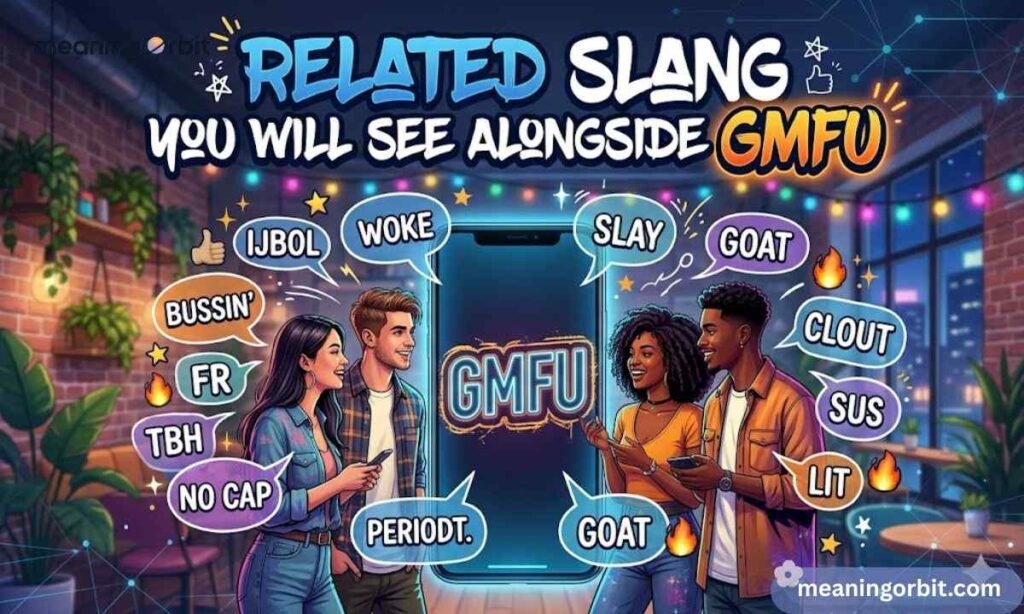
If you are decoding a text full of slang, GMFU rarely shows up alone. Here are some related terms that often appear in the same conversation:
- No cap: Meaning “no lie” or “for real.” Example: “No cap, that GMFU.”
- Lowkey / Highkey: Indicating the degree of a feeling. “Highkey GMFU right now.”
- Bussin: Meaning something is really good. Not related to GMFU in meaning, but often nearby in casual texts.
- Deadass: Meaning completely serious. “Deadass, this situation GMFU.”
- On God: Emphasizing sincerity, similar to “I swear.” “On God, that GMFU.”
Seeing these words together is usually a sign you are reading informal, emotionally charged communication. The context will always tell you whether the person is angry, amazed, or just venting.
The Emotional Range Behind GMFU: More Than Just Anger
It is worth spending a moment here because this is where nuance matters most. GMFU gets unfairly boxed into the “angry slang” category, but that misses a big part of how people actually use it.
Think about the last time something surprised you so completely that you did not know how to react. Maybe it was an unexpected act of kindness, a plot twist in a show, or news that left you speechless. That emotional overflow, that “I cannot process this right now” feeling, is exactly what GMFU captures in those situations.
The phrase works because it is honest about overwhelm. It does not try to be polished or composed. And in a world where people often curate their emotions carefully, GMFU gives permission to just say: this hit different and I am not okay about it.
Frequently Asked Questions
Is GMFU always used in a negative way?
Not always. While it is most commonly used to express frustration or disrespect, it can also describe being emotionally overwhelmed by something positive, like an incredible performance or a touching moment. Context is everything.
Can GMFU be used in a funny or sarcastic way?
Absolutely. In casual texting, people often use GMFU with humor, like complaining about their alarm clock or a bad meal. The strong phrasing paired with a minor inconvenience creates a comedic contrast that feels relatable and funny.
Is GMFU appropriate for all ages and audiences?
No. Because the full phrase contains explicit language, GMFU is best kept to informal settings between people who are comfortable with that level of casual communication. In professional, academic, or formal contexts, it should be avoided entirely.
Conclusion
By now, the mystery is gone. GMFU means “Got Me F***ed Up,” and it is one of the most emotionally honest phrases in modern slang. It does not dress anything up. It says exactly what the person is feeling, whether that is anger, disbelief, or being completely shaken by something.
It grew out of real human expression, spread through music and social media, and landed in everyday texting because it fills a gap that more polished language often cannot.

William is a dedicated writer in the meaning niche with 4 years of experience, helping readers understand the true meanings of words and ideas in a simple way.His goal is to make understanding meanings simple, useful, and engaging for everyone.
