

You got a text with SYFM and now you’re staring at your screen wondering if you just got complimented or insulted. Fair question. SYFM stands for “Shut Your F*ing Mouth”** — it is a blunt, aggressive slang abbreviation used in text messages and social media to tell someone to stop talking immediately.
There is nothing subtle about it. You will know right away when someone means it. Now that you have the quick answer, let’s walk through everything else you need to know so you never get caught off guard again.
What Does SYFM Mean in Texts?
SYFM is an acronym that stands for “Shut Your F*ing Mouth.”** People use it in text conversations, online chats, and social media comments when they want someone to stop talking — and they want that person to know they mean business.
It belongs to a larger family of internet slang that uses strong, direct language to express frustration, anger, or sometimes even playful teasing between close friends.
The message it sends is immediate and unmistakable. When someone sends you SYFM, they are not leaving room for interpretation.
Is SYFM Always Meant as an Insult?
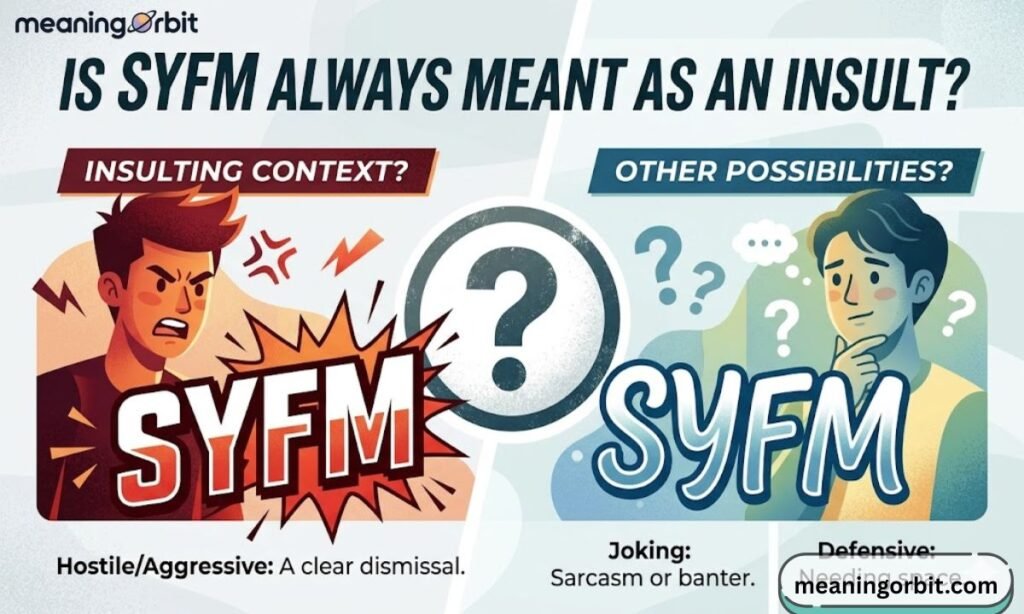
Not always, but mostly yes. Context does a lot of heavy lifting here.
In most cases, SYFM is used aggressively — during arguments, heated online debates, or when someone feels genuinely fed up with another person’s words. In that context, it carries real hostility and should be taken seriously.
However, between very close friends who regularly tease each other, SYFM can occasionally be used humorously — the same way friends might jokingly tell each other to “shut up” when something unbelievable happens. Think of the moment when your friend says something so wild that you respond with “No way, shut up!” — that energy.
The safest approach is to look at the tone of the conversation before assuming it is playful. If the chat has been tense, it is almost certainly not a joke.
Where Did SYFM Come From?
SYFM grew out of internet culture in the early 2000s, right alongside the explosion of text messaging, online forums, and chat rooms. During that period, people started condensing common phrases into acronyms to save time while typing on small keyboards.
Phrases built around “shut up” had already been part of everyday spoken language for generations. When internet slang took off, those phrases naturally got compressed. STFU (Shut The F*** Up) became one of the first popular variants, and SYFM followed as a slightly different construction with the same aggressive energy.
Over time, abbreviations like these spread from niche online communities into mainstream texting culture, where they are now widely recognized — even by people who would never use them personally.
SYFM vs. Similar Slang: A Quick Comparison
People often confuse SYFM with similar-sounding abbreviations. Here is a clear breakdown so you know exactly what each one means.
| Acronym | Full Meaning | Tone | How Common |
| SYFM | Shut Your F***ing Mouth | Very aggressive | Moderate |
| STFU | Shut The F*** Up | Aggressive | Very common |
| SYM | Shut Your Mouth | Mild to moderate | Less common |
| SMH | Shaking My Head | Disappointed/frustrated | Very common |
| IDGAF | I Don’t Give A F*** | Dismissive | Very common |
STFU is the most commonly used version. SYFM tends to feel more targeted and personal because it specifically references the mouth, which adds a slightly sharper edge to the message.
Real-Life Examples of SYFM in Text Conversations
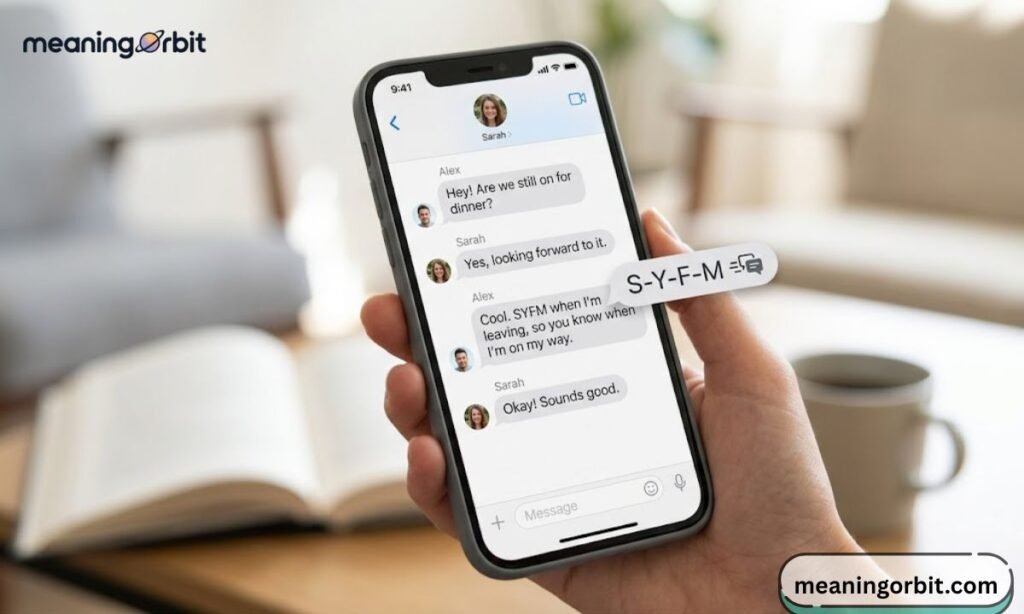
Seeing a word in context always makes the meaning click faster. Here are a few realistic scenarios where SYFM might appear.
Example 1 — During an argument:
Person A: “You always do this, you never listen to anyone.” Person B: “SYFM, you have no idea what you’re talking about.”
Example 2 — In a group chat (heated moment):
“Can everyone please SYFM for five seconds and let me explain?”
Example 3 — Between close friends joking around:
Person A: “I told you that song was going to be a hit.” Person B: “Okay fine, SYFM, you were right.”
Notice how the third example only works because the relationship is casual and the tone has been lighthearted throughout. That context makes all the difference.
Does SYFM Have Any Other Meanings?
In rare cases, people have used SYFM to mean other things, though these are far less common and mostly context-specific.
Some users in gaming communities have used it as “Show You Fing More”** — usually in a competitive or bragging context after a big play. Others have occasionally used it as “Support Your Fing Mates”** in social media posts about loyalty and friendship.
However, unless you are in a very specific online community where a different meaning has been established, you can safely assume SYFM means “Shut Your F*ing Mouth”** in almost every situation you will encounter.
A Note on the Language Behind SYFM
SYFM contains an expletive, and that matters depending on who is reading the message.
From a purely linguistic standpoint, it follows the same pattern as many internet-age acronyms that compressed aggressive spoken phrases into fast-typing shorthand. The internet created a kind of written version of the way people already spoke in frustration — and SYFM is one example of that.
Interestingly, even though the phrase is harsh, using an acronym softens the visual impact slightly. Typing SYFM versus typing out the full phrase feels different to both the sender and the reader. That psychological buffer is one reason why these abbreviations became so popular online — people could express strong emotions with a bit of plausible deniability.
When Should You Use SYFM (And When Should You Not)?
Let’s be honest — SYFM is not a term for most situations. Here is a practical guide.
It might be acceptable when:
- You are with very close friends who have an established teasing dynamic
- You are playing an online game and trash talk is part of the culture
- The conversation is clearly joking from start to finish
You should avoid it when:
- Talking to coworkers, employers, or professional contacts
- Communicating with family members, especially older relatives
- Responding to strangers online where it could escalate conflict
- Texting anyone who has not established that kind of casual tone with you
If you are unsure whether the relationship allows for language like this, the answer is usually no. Strong abbreviations like SYFM can damage relationships quickly because there is no tone of voice to soften them in text form.
How to Respond If Someone Sends You SYFM

Getting hit with a SYFM in a text can feel jarring, especially if you did not expect it. Here is how to handle it based on the situation.
If it was clearly meant as an insult: Take a breath before responding. Replying immediately with equal aggression almost always makes things worse. You can simply ask what prompted it, disengage for a while, or address it calmly when both sides are cooler.
If it was likely a joke: A light response like “okay, okay, I get it” keeps the tone casual and does not create unnecessary drama.
If you are genuinely unsure: Ask directly. Something like “Are you actually upset or just messing around?” is perfectly reasonable and avoids misreading the situation.
Common Mistakes People Make With SYFM
A few misunderstandings pop up around this abbreviation regularly.
Mistake 1: Confusing SYFM with STFU. They are similar but not identical. STFU is more universally recognized. If you use SYFM and the other person has never seen it, they may look it up and be even more offended by the spelled-out version than they would have been if you had just said it plainly.
Mistake 2: Using it professionally. This one should go without saying, but it happens. Work chats, professional emails, and LinkedIn comments are never the right place for language like this — even as a joke.
Mistake 3: Assuming it is always a joke. Some people send SYFM thinking the other person will laugh it off, without realizing the recipient is genuinely hurt or angry. Read the room carefully before using it even in a light context.
Which Version Should You Use: SYFM or STFU?
If you are deciding between the two, here is the practical answer.
Use STFU if you want to be understood immediately by virtually anyone. It is the most recognized version, it carries a similar punch, and you are far less likely to get a confused “what does that mean?” in response.
Use SYFM only if you are certain the other person knows the abbreviation and if the context supports it. It is slightly more specific and personal in its phrasing, which can make it feel more pointed in arguments or more exaggerated in jokes — but only if both sides are on the same page.
When in doubt, STFU gets the message across faster. And if you are genuinely trying to express displeasure in a conversation, typing out your actual thoughts is always more effective than any acronym.
Frequently Asked Questions
Is SYFM appropriate to use in public social media posts?
Not really. Even on casual platforms, using SYFM in a public post can come across as unnecessarily aggressive to people outside your immediate circle. Direct messages are a slightly different story, but public posts can easily be misread by a wider audience.
Can SYFM be used in a funny or sarcastic way?
Yes, but only between people with an established joking relationship. Sarcasm and humor are extremely hard to convey through text. If there is even a small chance the other person might take it seriously, it is better to skip it or add context like an emoji to signal the tone.
Are there politer alternatives to SYFM that still express frustration?
Absolutely. Phrases like “Please stop,” “I need a moment,” or even a simple “I disagree and I do not want to continue this conversation right now” do a much better job of communicating frustration without the risk of escalating things further.
Final Thoughts
SYFM means “Shut Your F*ing Mouth”** and it says exactly what it means with zero softening. It lives at the aggressive end of internet slang and should be used only with full awareness of your audience and relationship.
Now that you know what it means, where it came from, how it compares to similar slang, and when to use it (or not), you will never be caught off guard by it again. And if someone sends it your way, you will know exactly how to read the room and respond.

William is a dedicated writer in the meaning niche with 4 years of experience, helping readers understand the true meanings of words and ideas in a simple way.His goal is to make understanding meanings simple, useful, and engaging for everyone.
