

You just got a message ending with “XO” and now you are staring at your screen wondering if that means something romantic, friendly, or just casual. You are not alone. XO meaning in text confuses a surprising number of people every single day. So here is the short answer: XO means hugs and kisses.
The “X” stands for a kiss, and the “O” stands for a hug. People use it to express warmth, love, or affection at the end of a message. Simple as that. Now let us go a little deeper, because the story behind XO is actually more interesting than you might think.
What Does XO Mean in Text?
XO is a shorthand expression of love and affection. When someone sends you “XO” in a text, they are sending you both a kiss (X) and a hug (O). It is one of the oldest letter combinations in digital communication, and it has survived every trend from AIM chats to Instagram DMs.
You will usually see it at the end of a message, the way someone would sign off a letter with “Love” or “Take care.” It is warm, sweet, and intentional. If someone sends you XO, they want you to feel good. That is the whole point.
Where Did XO Come From? The History Behind the Symbol

Here is where things get interesting. The origin of XO goes back centuries, and there are two popular theories about how X became a kiss and O became a hug.
The X as a kiss traces back to medieval times. In an era when most people could not read or write, they would sign documents with an “X” and then kiss it as a sign of sincerity, the same way people swore on the Bible. Over time, the X itself became associated with the act of kissing.
The O as a hug has a less certain origin. One popular theory suggests it started with Jewish immigrants in America who refused to sign with an X (because of its Christian cross association) and instead used an O. The circular shape of arms wrapping around someone in a hug made the O a natural symbol for embrace.
Together, XO became a pair. By the 20th century, people were already writing XOXO in love letters, and the combination stuck around long enough to make it into every texting app on the planet.
Is X the Kiss or the Hug? (People Get This Backwards All the Time)
Here is the most common point of confusion, and honestly, it trips up even native English speakers. Most people assume X looks like crossed arms in a hug and O looks like puckered lips for a kiss. But it is actually the opposite.
| Symbol | Meaning | Why |
| X | Kiss | Medieval tradition of kissing the X signature |
| O | Hug | Arms wrapped around someone in a circle |
| XO | Kiss + Hug | Combined expression of affection |
| XOXO | Kisses + Hugs (repeated) | Stronger, warmer emphasis |
So if you have been sending Xs thinking you were giving hugs, you have been kissing people. Do not worry about it. The meaning still gets through because most people focus on the warmth of the gesture, not the technical breakdown.
Does XO Mean the Same Thing in All Contexts?
Not always. Context changes the weight of XO significantly. Here is how it shifts depending on who sends it and where.
From a romantic partner: XO carries clear affection. It is a digital kiss and hug, and it lands exactly that way.
From a close friend: XO is warm and caring, but not necessarily romantic. Many close friends use it the same way they would say “love you” without it being anything more than friendship.
From a parent or family member: Completely normal. XO is a generational habit in many families and simply means “I love you” in shorthand.
From a coworker or business contact: This is where it gets a little awkward. XO is generally too personal for professional settings unless you have a very casual relationship with the person.
From a celebrity or brand: This one is almost meaningless. Beyoncé literally named her album XO. When influencers and brands use it, it is more of a sign-off habit than genuine affection.
Real Life Examples of XO in Text Conversations
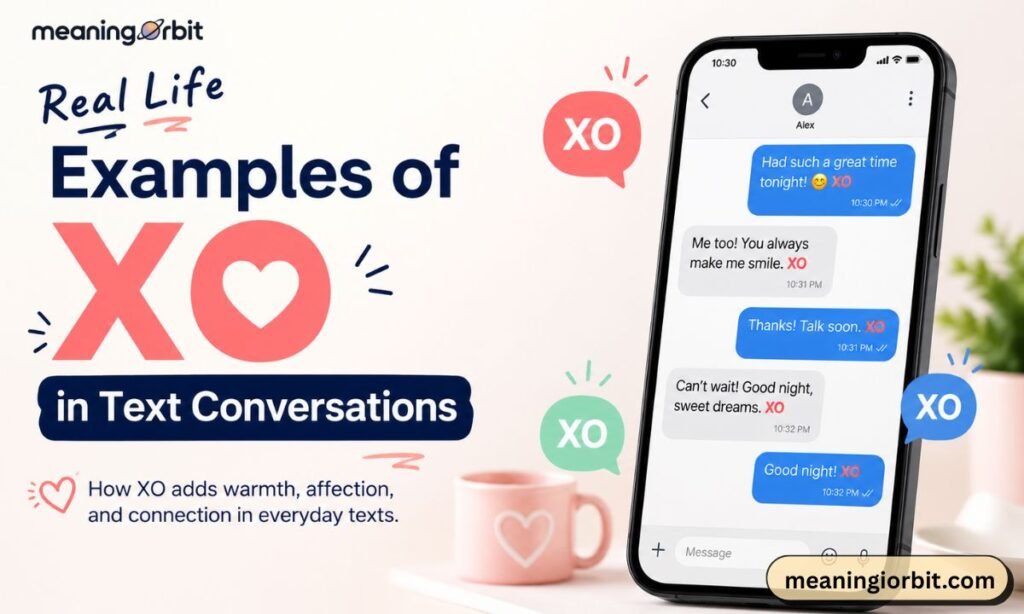
Sometimes it helps to just see it in action. Here are a few natural examples of how XO shows up in everyday texting.
Example 1 (Romantic): “Had the best time with you tonight. Can’t wait to see you again. XO”
Example 2 (Friendly): “Miss you so much! Come visit soon. XO”
Example 3 (Family): “Hope your day went well, sweetheart. Call me when you can. XO, Mom”
Example 4 (Too casual for work): “Great meeting today, everyone! See you next week. XO” — This one is best avoided unless your team is extremely close-knit.
The tone of the rest of the message always sets the stage for how XO lands. Pay attention to that before you overthink the two letters.
XOXO vs XO: Is There a Difference?
Yes, there is a difference, though it is mostly one of intensity rather than meaning.
XO is one kiss and one hug. It is affectionate, warm, and casual. You would use it the way you would wave goodbye to a close friend.
XOXO is repeated kisses and hugs. It carries more emotional weight and feels more expressive. Think of it as the difference between a quick hug and squeezing someone twice before letting go.
Some people also use XOXOXO when they are being especially playful or dramatic. At that point it is less about counting affection and more about adding energy to the message. The more letters, the more enthusiastic the sender feels.
Also Read This: What Does OKG Mean in Text?
XO in Pop Culture: Why You Keep Seeing It Everywhere
XO has become part of pop culture in a big way. Beyoncé released a song called “XO” in 2013, and The Weeknd performs under the brand XO, which is also the name of his record label.
Even fashion brands have leaned into the aesthetic of XO because it reads as effortlessly cool and affectionate at the same time.
This pop culture presence has actually shifted how people perceive XO slightly. For younger audiences especially, XO can sometimes feel more like a stylistic phrase than a literal expression of affection, similar to how “love you” gets said so casually it barely registers anymore. Context still rules, but the cultural weight of XO has broadened.
Biblical and Historical Significance of the X Symbol
The letter X carries more history than most people realize. In Christian tradition, X has long been used as an abbreviation for Christ, because X is the Greek letter Chi, the first letter of “Christos.”
This is why you see “Xmas” as a shorthand for Christmas. It was never meant to remove Christ from the holiday. It was a scholarly abbreviation used for centuries.
This sacred association with X is part of why signing with an X and kissing it carried such weight in medieval Europe.
It was not just a signature. It was a vow made before God. That level of sincerity is baked into the very origin of X as a symbol for a kiss.
So the next time someone sends you XO, just know that the little X has a surprisingly serious backstory behind it.
Common Mistakes People Make With XO
Knowing what XO means is only half the battle. Knowing when NOT to use it is equally important.
Mistake 1: Using XO in professional emails. Unless you work somewhere with an extremely casual culture, XO does not belong in work communication. It can make things awkward fast.
Mistake 2: Misreading XO as a romantic signal. Sometimes XO is just a habit. Some people send it to literally everyone. Do not assume someone is confessing feelings just because they ended a text with XO.
Mistake 3: Responding too literally. If someone sends XO and you respond with “thanks for the hug and kiss,” it will feel forced. Just let the warmth land and respond naturally.
Mistake 4: Overusing it. When you send XO in every single message, it loses its warmth. Like any expression of affection, it means more when it is not handed out constantly.
Which Should You Use: X, O, XO, or XOXO?
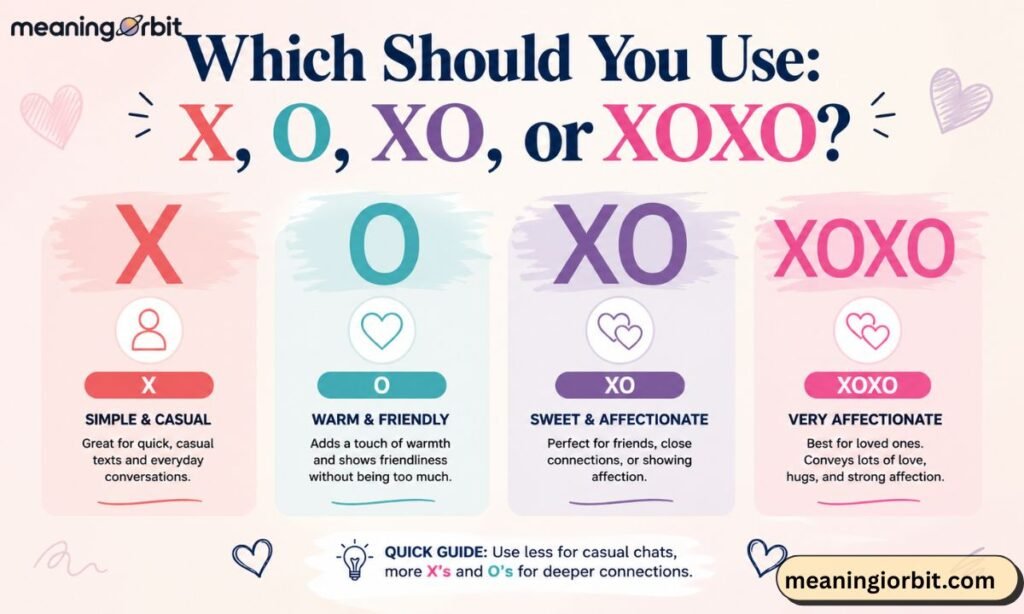
Here is a simple guide to help you pick the right one.
Use X when you want to send a quick kiss in a playful, flirty way. Common in British texting culture where X is tacked onto the end of messages very casually.
Use O almost never on its own. A lone O does not really communicate a hug without the X next to it. It just looks like a circle.
Use XO when you want to be warm and affectionate without going over the top. Great for friends, family, and romantic partners in everyday conversation.
Use XOXO when you want to add extra emotional energy to a message. Perfect for birthdays, celebrations, goodbyes, or when you just really miss someone.
When in doubt, XO is the safe and sweet choice.
How Different Generations Use XO
XO means slightly different things depending on who is sending it. This is not a complaint about any generation, just an observation worth knowing.
Older generations, especially those who grew up writing letters, tend to use XO more deliberately. It carries weight for them because it came from a tradition of signed affection.
Younger generations, particularly Gen Z, often use XO more casually or even ironically. You might see it used in memes or sarcastically in response to something ridiculous. It has taken on a kind of playful, sometimes detached energy in certain digital spaces.
Millennials tend to land somewhere in the middle, using XOXO with genuine warmth but also with awareness of its cultural associations from reality TV, pop music, and texting habits.
No matter the generation, the core meaning has not disappeared. It just travels with slightly different baggage.
Frequently Asked Questions
Does XO always mean romantic love?
No. XO is used between romantic partners, close friends, and family members. It expresses affection broadly, not exclusively romantic love. Pay attention to your relationship with the sender for context.
Is it weird if a guy sends XO?
Not at all. Men use XO too, especially with close friends, family, or partners. In some cultures and friend groups it is completely standard. The idea that XO is only for women is outdated.
Can I use XO in a professional message?
Generally, no. XO is too personal for most professional settings. Stick to “Best,” “Warm regards,” or “Take care” when signing off work emails or messages.
Conclusion
XO meaning in text is beautifully simple: it means kisses and hugs. X is the kiss, O is the hug, and together they form one of the most universally understood expressions of affection in digital communication. It has roots going back to medieval Europe, survived centuries of cultural shifts, and somehow made it all the way into your text messages looking as relevant as ever.
Use it with intention, use it with warmth, and if you are ever unsure whether the context calls for it, just ask yourself: would I hug this person in real life? If yes, XO is probably just fine.

William is a dedicated writer in the meaning niche with 4 years of experience, helping readers understand the true meanings of words and ideas in a simple way.His goal is to make understanding meanings simple, useful, and engaging for everyone.

1 thought on “XO Meaning in Text: What It Really Means and How to Use It Right”