

You got a message that says “OOO” and now you’re staring at your screen like it’s written in ancient code. Are they excited? Confused? Shouting? Nope.
“OOO” in text simply means “Out of Office.” It tells you that someone is away from work and not available to respond right now. That’s it. Short, sweet, and slightly anticlimactic — but now you know.
What Does “OOO” Mean in Text?
“OOO” stands for “Out of Office.” It is a short abbreviation used in professional communication — mostly in emails, workplace chats, and text messages — to let people know you are not available during working hours.
When someone sends you “OOO” or sets an OOO auto-reply, it usually means:
- They are on vacation, sick leave, or a personal day
- They will not respond immediately
- There may be a point of contact listed for urgent matters
Think of it as the digital version of taping a “Gone Fishing” sign on your office door — except far less charming and far more professional.
Where Did “OOO” Come From?
The abbreviation OOO grew naturally from corporate email culture in the late 1990s and early 2000s. As email became the primary tool for workplace communication, professionals needed a fast, clear way to say “I am not here right now.”
The phrase “Out of Office” already existed in workplace vocabulary. The shortening to OOO happened organically, the same way most internet abbreviations do — people typed it enough times that the short version just stuck.
Today, almost every major email platform — Gmail, Outlook, Apple Mail — has a built-in “Out of Office” auto-reply feature that uses this exact terminology. That built-in feature made “OOO” a globally recognized workplace shorthand.
OOO vs. OOO: When Three O’s Mean Something Completely Different
Here is where it gets a little interesting. Context matters a lot with “OOO” because it can mean two totally different things depending on where you see it.
| Context | Meaning | Example |
| Professional email or work chat | Out of Office | “I’ll be OOO from Dec 24 to Jan 2.” |
| Casual text or social media | Expression of surprise or disgust | “OOO that was not okay.” |
| Informal chat between friends | Reaction filler (like “oooh”) | “OOO she really said that?” |
So if your coworker messages you “OOO next week,” they are going on leave. But if your friend texts “OOO I cannot believe that,” they are most definitely NOT going on vacation.
How “OOO” Is Used in Professional Settings
In a workplace context, OOO shows up in a few common places:
Email subject lines:
“Re: Project Update — Sarah is OOO until Monday”
Auto-reply messages:
“Thank you for your email. I am currently OOO from June 10–15. For urgent matters, please contact Mark at mark@company.com.”
Slack or Teams messages:
“Hey, just a heads-up — I’ll be OOO tomorrow for a doctor’s appointment.”
Calendar blocks:
Employees often block their calendars with an OOO event so colleagues can see their availability at a glance.
The beauty of OOO is its efficiency. Three letters communicate what would otherwise take an entire sentence. That is the whole point of workplace shorthand.
How “OOO” Is Used in Casual Texting
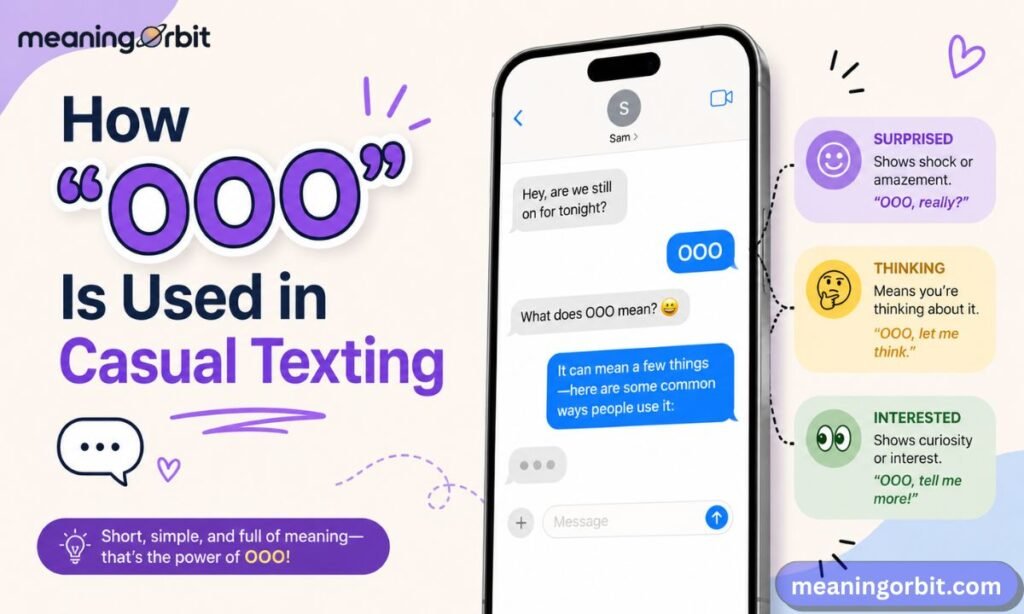
Outside the office, OOO takes on a completely different personality. In casual texts or comment sections, it functions more like a verbal reaction — similar to “ooh” or “oof.”
Real-life casual examples:
- “OOO that pizza looks amazing” — expression of excitement
- “OOO no she didn’t” — expression of shock
- “OOO that hurt just reading it” — expression of secondhand pain
This informal version is especially common among Gen Z and millennial texters who use it as a conversational filler to react to something surprising, appetizing, or dramatic. It carries energy that a simple “wow” just does not quite capture.
Related Terms You Should Know
While you are here, a few related abbreviations often appear alongside OOO in professional communication:
WFH — Working From Home. The person IS available, just not physically in the office.
PTO — Paid Time Off. The official HR term for the days someone takes off. Going OOO often means using PTO.
EOM — End of Message. Used to signal there is nothing more to say after a short email subject line.
OOTO — Out of the Office. A slightly longer variation of OOO used in some corporate environments. Both mean the same thing.
Knowing these terms makes workplace communication feel a lot less like deciphering a secret code.
OOO vs. WFH: What Is the Difference?
People sometimes confuse OOO and WFH, but they are not the same thing.
| OOO (Out of Office) | WFH (Work From Home) | |
| Available? | No | Yes |
| Responding to emails? | Delayed or not at all | Yes, normally |
| At a computer? | No | Yes |
| Common reason | Vacation, sick day, personal leave | Remote work day |
If your colleague says “I am WFH today,” you can still reach them. If they say “I am OOO today,” give them space. That distinction matters more than most people realize, especially when someone sends an urgent message and wonders why they are being ignored.
Common Mistakes People Make With “OOO”
Even a three-letter abbreviation comes with ways to use it wrong. Here are the most common ones:
Mistake 1: Not setting an OOO auto-reply.
You go on vacation, forget to set the auto-reply, and colleagues spend three days wondering if you fell off the planet. Always set it before you leave.
Mistake 2: Using OOO in a formal letter or document.
Abbreviations belong in quick messages and emails. In a formal report or letter, write out “Out of Office” in full.
Mistake 3: Confusing OOO with WFH.
Saying “I’ll be OOO but reachable” creates confusion. If you are reachable, you are not fully OOO. Be specific about your availability.
Mistake 4: Not including a return date.
An OOO message that just says “I am away” tells people nothing useful. Always add when you will be back and who to contact in the meantime.
How to Write a Good OOO Message
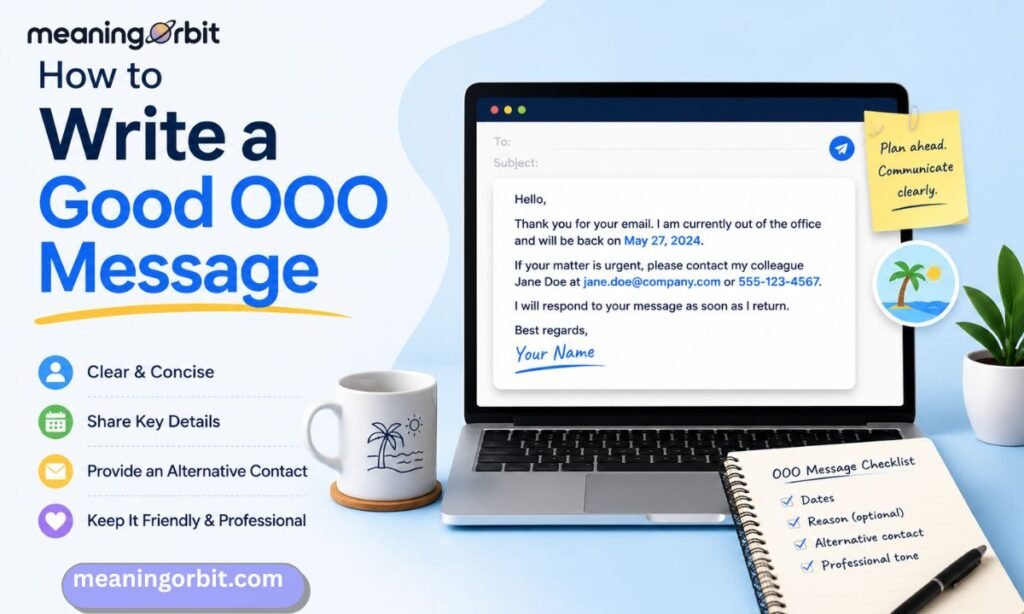
A great Out of Office auto-reply does three things: it confirms you are away, it tells people when you return, and it gives them a backup contact. Here is a simple formula:
“Hi, thank you for your message. I am currently out of office from [date] to [date] and will have limited access to email. I will respond as soon as possible upon my return. For urgent matters, please reach out to [name] at [email].”
Keep it brief. Keep it helpful. Do not write a novel. Nobody reads a six-paragraph OOO message.
Does “OOO” Have Any Historical or Older Origins?
Not in a dramatic, ancient-civilization sort of way — but the concept behind OOO has always existed. Before email, people left physical notes on their desks, asked receptionists to take messages, or simply let calls go to voicemail.
The telephone answering machine of the 1970s and 1980s was essentially the original OOO system. You recorded a message saying you were unavailable and asked people to leave a callback number. Same idea, different technology.
Frequently AAsked Questions
Is “OOO” only used in professional settings?
No. While its primary meaning is “Out of Office” in professional communication, it is also used casually in texts and social media as a reaction or exclamation. Context tells you which meaning applies.
What is the difference between OOO and OOTO?
Both mean “Out of Office.” OOO is the more common version. OOTO (Out of the Office) is a slightly more formal variation used in some corporate environments, but they are functionally identical.
Should I write “OOO” or “Out of Office” in my auto-reply?
In the subject line or a chat message, OOO is fine. In the body of a professional email auto-reply, write out “Out of Office” in full for clarity and polish.
Conclusion
“OOO” is one of those small pieces of language that carries a surprising amount of weight in modern communication. In a workplace message, it protects your time off and keeps colleagues informed. In a casual text, it adds energy and reaction to a conversation.
The next time you see OOO pop up, you will know exactly what it means — and more importantly, you will know what it means based on where you see it. That context awareness is what separates confident communicators from confused ones.

William is a dedicated writer in the meaning niche with 4 years of experience, helping readers understand the true meanings of words and ideas in a simple way.His goal is to make understanding meanings simple, useful, and engaging for everyone.
