

You just got a message that ends with “TTY” and now you’re staring at your screen wondering if it’s a typo, a secret code, or some tech term you missed in school. Relax you are not alone.
TTY in text confuses a surprising number of people because it actually has more than one meaning depending on where you see it. Let’s fix that confusion right now.
What Does TTY Mean in Text?
TTY stands for “Talk To You.” When someone uses it in a text message or online chat, they simply mean they will speak with you later. It works the same way as “catch you later” or “speak soon.” So if a friend texts you “GTG, TTY!” — they are saying they have to go and will talk to you again soon.
The Two Versions You Need to Know: TTY vs. TTYL
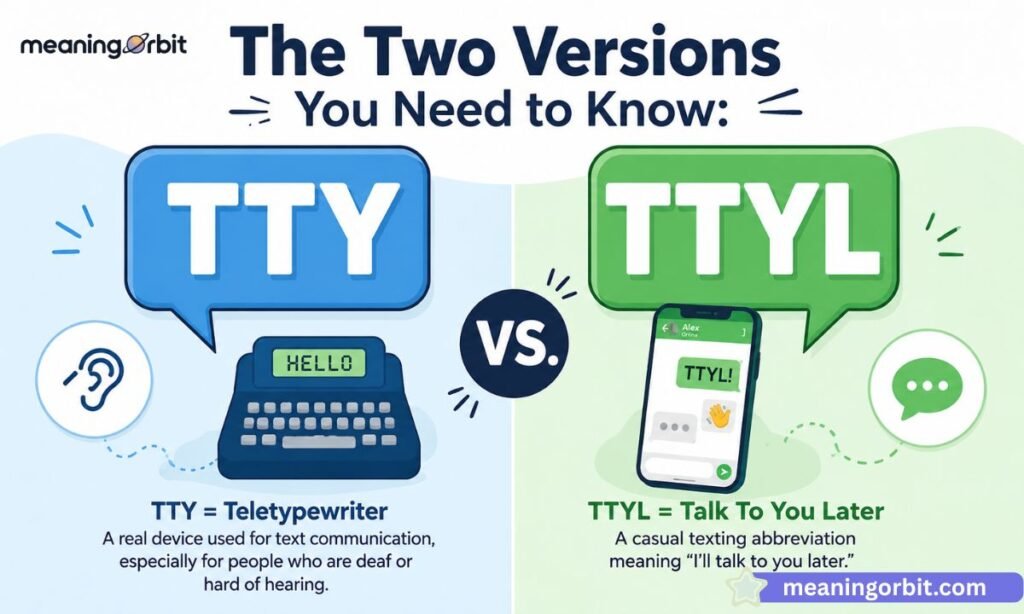
Here is where people trip up most often. TTY and TTYL look almost identical, but they carry slightly different feelings.
TTYL means “Talk To You Later” — and the added “L” at the end makes it more specific. It is the more complete, more popular version that most people recognize instantly.
TTY, on the other hand, is the shorter, more casual drop. Some people use TTY when they are in a rush and simply chop the last letter off. Others use it as a slightly different variation meaning “Talk To Ya” — keeping the same spirit but sounding more relaxed and informal.
A Quick Comparison: TTY, TTYL, and Similar Slang
| Abbreviation | Full Meaning | Tone | Best Used When |
| TTY | Talk To You | Casual, quick | Wrapping up a chat fast |
| TTYL | Talk To You Later | Friendly, common | Standard goodbyes |
| TTYS | Talk To You Soon | Warmer, closer | When you plan to reconnect quickly |
| BRB | Be Right Back | Very casual | Short breaks mid-conversation |
| GTG | Got To Go | Casual, urgent | Leaving suddenly |
The Other TTY Meaning You Should Know
Here is the part most casual articles skip entirely — and it actually matters.
TTY also stands for “Teletype” or “Teletypewriter.” This is a completely different meaning, and it lives in two separate worlds.
In telecommunications and accessibility, a TTY device is a physical machine that allows people who are deaf, hard of hearing, or speech-impaired to communicate over telephone lines by typing text instead of speaking. This technology gave millions of people access to phone communication long before smartphones existed.
In computing and Unix/Linux systems, TTY refers to a terminal interface. When developers or system administrators talk about TTY in this context, they are referring to a text-based input/output session — basically a way to communicate directly with a computer through commands.
So if your friend texts “TTY,” they mean they will talk to you later. But if your IT colleague says “open a TTY session,” they are definitely not saying goodbye.
Where Did TTY Come From? A Brief History
The Teletypewriter came first. It dates back to the early 20th century, when telegraph operators needed machines that could send and receive typed messages over long distances automatically. By the mid-1900s, TTY machines became essential tools for the hearing-impaired community, allowing them to use telephone networks in a way previously impossible.
Fast forward to the internet boom of the 1990s. Online chat rooms, instant messaging platforms like AIM, and SMS texting exploded in popularity. With character limits tight and fingers flying across keyboards, people began compressing common phrases into initials. “Talk To You Later” became TTYL. Over time, TTY broke off as the even shorter cousin.
Real-Life Examples of TTY in Text Conversations
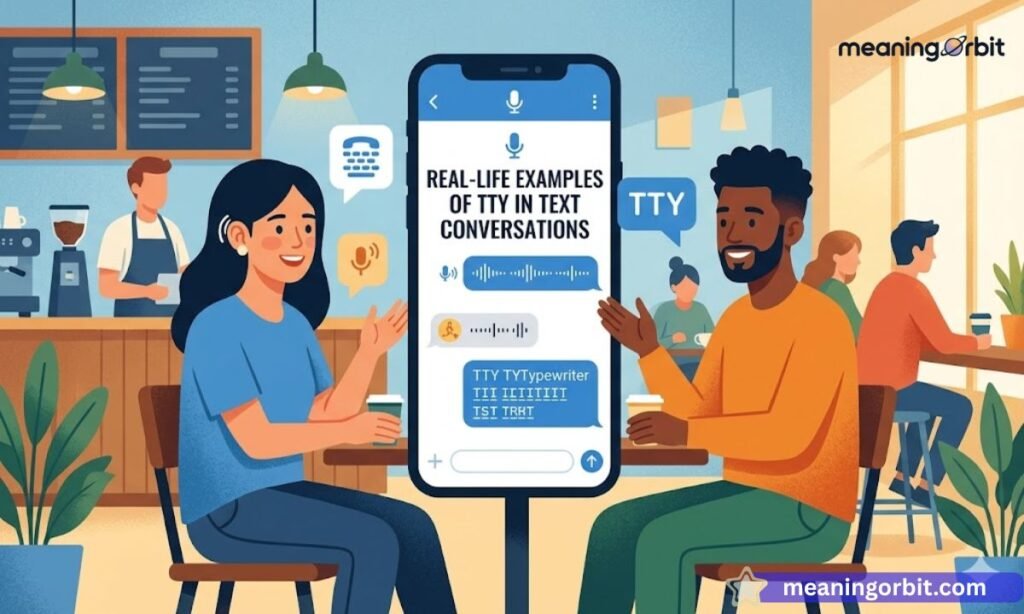
Seeing slang in action makes it click instantly. Here are a few natural examples:
Example 1 — Ending a chat:
Friend: “I have to run, meeting starts in 2 mins!” You: “No worries, TTY!”
Example 2 — Quick goodbye:
“Dinner’s ready, gotta go. TTY later!”
Example 3 — TTYL vs. TTY:
“I’ll call you tonight. TTYL!” (More specific, implies an actual later conversation) “Okay bye! TTY.” (Quick, informal, breezy)
Example 4 — Wrong context (the mistake):
Texting a professional contact “TTY!” when ending a business chat. That would be a small awkward moment — save it for friends.
Common Mistakes People Make With TTY
Even simple slang comes with traps. Here are the mistakes worth avoiding:
Confusing TTY with TTYS. TTYS means “Talk To You Soon” and implies you will reconnect in a shorter time frame. TTY is more open-ended. Using the wrong one can send mixed signals about when you actually plan to respond.
Using TTY in professional settings. Emails to a manager, messages to a client, or texts to someone you have never met informally — none of these are the right places for TTY. Keep it between people you already have a relaxed dynamic with.
Assuming it always means “Talk To You.” If someone in a tech forum or Linux community mentions TTY, they are almost certainly talking about a terminal interface. Context is everything.
Forgetting the deaf and hard-of-hearing context. In formal writing or accessibility discussions, referring to TTY loosely as just “texting slang” without acknowledging its deeper meaning can come across as dismissive of something that genuinely changed people’s lives.
TTY in the Context of Accessibility: Why It Still Matters
It would be easy to write off TTY as just an old technology now replaced by smartphones and text messaging. But that would miss the point entirely.
TTY devices were genuinely revolutionary. Before them, deaf individuals simply could not use a telephone. A TTY machine, combined with a relay service where an operator would read and voice the typed message to the hearing person on the other end, opened up an entire world of communication.
Many countries still maintain TTY relay services legally. In the United States, for example, the Americans with Disabilities Act (ADA) requires telephone companies to offer telecommunications relay services. The number 711 connects users to TTY relay operators across the country.
Which Version of TTY Should You Use?
Here is the practical guide:
Use TTY (Talk To You) when you want a breezy, quick goodbye in an informal text or chat. It works best with friends, family, or close colleagues in casual conversations.
Use TTYL when you want something slightly warmer and more recognizable. Most people immediately understand TTYL, even if they have never seen TTY before.
Use TTYS when you genuinely plan to reconnect soon — like within the same day or the next morning.
Reference TTY (Teletypewriter) when discussing phone accessibility, assistive technology, hearing-impaired communication, or Unix/Linux terminal sessions.
Related Slang Worth Knowing Alongside TTY
While you are here, a few neighbors of TTY are worth having in your back pocket:
BRB (Be Right Back) — Used mid-conversation when you need a short break. Unlike TTY, BRB implies you are coming back to the same conversation quickly.
AFK (Away From Keyboard) — Originated in gaming but now used broadly. It signals you have stepped away from your device temporarily.
CYL (Catch You Later) — A slightly older goodbye expression with the same spirit as TTY but a different flavor.
All of these belong to the same family of digital exit phrases — small, friendly signals that keep conversations human even when you are not there to respond.
Frequently Asked Questions
Is TTY the same as TTYL?
Not exactly. Both come from “Talk To You Later,” but TTYL is the complete, widely recognized version. TTY is the shorter, more informal variation. Some people also interpret TTY as “Talk To Ya” for a slightly more relaxed feel. Either way, the meaning is close enough that most people use them interchangeably in casual texting.
Can I use TTY in a professional email?
No. TTY is casual texting slang and has no place in professional communication. Stick to proper sign-offs like “Best regards,” “Talk soon,” or “Looking forward to hearing from you” in any work-related context.
What does TTY mean in phone or government services?
In this context, TTY refers to a Teletypewriter — a device and service that allows people who are deaf or speech-impaired to communicate via text over phone lines. Many government websites and emergency services list a TTY number specifically for this purpose.
Conclusion
TTY in text is one of those small three-letter combinations that quietly holds more history than most people expect. At its simplest, it means “Talk To You” — a casual, friendly way to close out a conversation.
At its deepest, it connects back to a technology that gave an entire community of people access to communication that the rest of the world took for granted.

William is a dedicated writer in the meaning niche with 4 years of experience, helping readers understand the true meanings of words and ideas in a simple way.His goal is to make understanding meanings simple, useful, and engaging for everyone.
