

You’ve seen it. Someone texted you “ion know about that” and you stared at your screen for a solid five seconds wondering if autocorrect had finally given up on them.
Or maybe you scrolled Instagram and someone commented “ion even care anymore” and you thought — is that a chemistry term? A typo? A cry for help? None of the above. It’s slang, and once you get it, you’ll start seeing it absolutely everywhere.
What Does ION Mean in Text?
ION means “I don’t.” That’s the short and simple answer.
When someone types “ion know” they mean “I don’t know.” When they write “ion think so,” they mean “I don’t think so.” It’s a shorthand contraction where the letters I, O, and N blend together to replace the phrase “I don’t” in casual digital conversation.
Why Does “I Don’t” Become ION?
When people say “I don’t” quickly in natural speech, it often sounds more like “I-on” — the “d” gets swallowed. Over time, that spoken shortcut made its way into texting. People started writing what they actually say out loud, not what the grammar books tell them to write.
This process is called phonetic reduction — a fancy way of saying “we got lazy with sounds and honestly that’s fine.” English has been doing this for centuries. We turned “cannot” into “can’t.” We turned “do not” into “don’t.” Now we’re turning “I don’t” into “ion.”
ION on Instagram Specifically What Changes?
On Instagram, ION appears in captions, comments, Stories, and DMs. The context is almost always informal and emotional — someone expressing doubt, disbelief, or unbothered energy.
You’ll see it in captions like:
- “ion fw fake people 🙅” (I don’t mess with fake people)
- “ion know why I’m still surprised lol”
- “ion even want to talk about it”
On Instagram especially, ION pairs naturally with other slang words like “fw” (fooling with / messing with), “lowkey,” and “fr” (for real). It fits the platform’s casual, fast-moving comment culture where nobody has time for full sentences and everyone communicates in vibe-coded shorthand.
The Second Meaning: ION as “In Other News”
Here’s where it gets slightly interesting. ION has a second, completely different meaning depending on the conversation.
In some texts and online spaces, ION stands for “In Other News.” This version is used to switch topics mid-conversation — sort of like a pivot move when you want to change the subject without making it awkward.
Example:
“Ugh that meeting was so long. ION, I found the best pizza spot yesterday.”
So context is everything. If someone says “ion know” — that’s “I don’t know.” If someone says something then adds “ION” before a totally different topic — that’s “In Other News.”
Quick Comparison Table: ION Meanings at a Glance
| Usage | Meaning | Example |
| ion + verb | I don’t | “ion want to go” |
| ion know | I don’t know | “ion know what happened” |
| ION + new topic | In Other News | “ION, the game was wild last night” |
| ion fw | I don’t mess with | “ion fw drama” |
| ion even | I don’t even | “ion even care anymore” |
Real-Life Examples of ION in Conversation
Seeing slang in a table is one thing. Seeing it in real conversations is where it clicks. Here are some natural examples:
Text message:
Friend: “You coming to the party Saturday?” You: “ion know yet, depends on work.”
Instagram comment:
Caption: “Should I cut my hair?” Comment: “ion think you should, it looks amazing rn”
Twitter/X:
“ion understand how people wake up early voluntarily. respect but ion get it.”
Topic switch (In Other News):
“My cat knocked over my water again. ION, anyone watching the new season yet?”
Once you see the pattern, you’ll notice it’s actually incredibly efficient. Two letters and a vowel do the work of five characters. Texters everywhere silently applaud.
Is ION Formal or Informal?
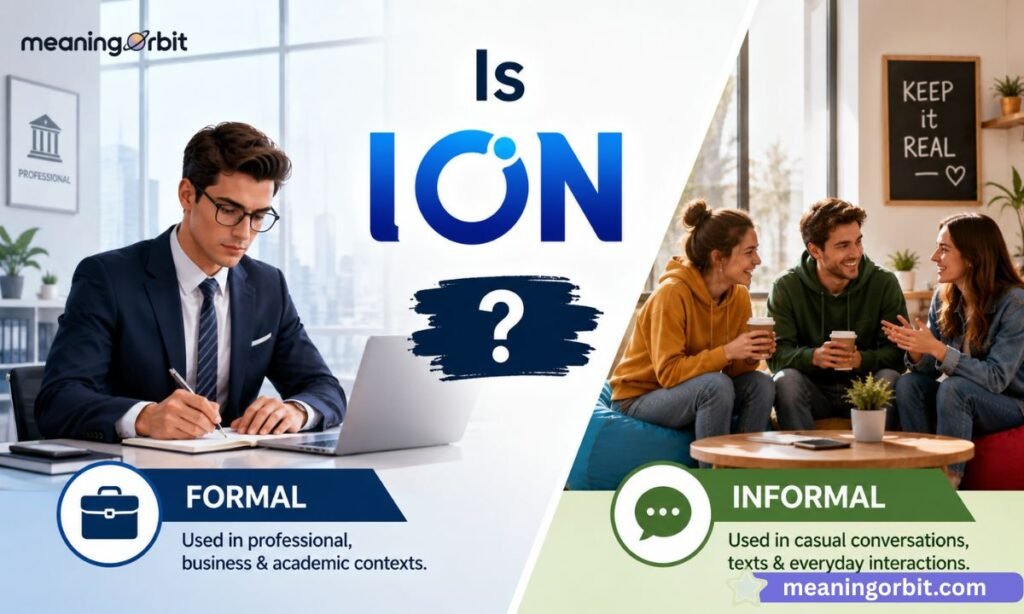
You should never use ION in professional emails, academic writing, job applications, or anywhere an actual adult decision-maker might read it. Your manager does not want to read “ion think the quarterly report is ready yet.”
ION belongs in:
- Text messages with friends
- Instagram comments and DMs
- Twitter, TikTok captions, Snapchat
- Group chats where everyone speaks fluent internet
Keep it where it belongs, and it works perfectly. Drag it into a work email, and suddenly you’re “ion” your way out of a promotion.
Common Mistakes People Make With ION
A few things people get wrong when they first encounter this slang:
Mistake 1: Thinking it means something technical. Some people see ION and immediately think of ions from chemistry class — charged atoms and all that. Unless someone is discussing physics in a text message (in which case, impressive), it’s slang.
Mistake 2: Misreading the topic-switch version. If someone drops “ION” mid-conversation before changing subjects, don’t read it as “I don’t.” Context tells you which meaning is active.
Mistake 3: Overusing it in places it doesn’t fit. ION sounds natural when it flows with the sentence. Forcing it into places it doesn’t fit just sounds awkward. Read it aloud. If it sounds right spoken, it works in text.
Mistake 4: Confusing ION with “Ion” as a name. Ион is actually a Romanian and Greek masculine name. If someone introduces themselves as Ion, please don’t reply “oh like I don’t?” That would be a rough start to any friendship.
Does ION Have Any Historical or Broader Roots?
Believe it or not, ION as a word has old roots — just not in the slang sense.
The word “ion” in science comes from the Greek word “ienai,” meaning to go. In chemistry, an ion is an atom that has gained or lost electrons and carries an electrical charge. Discovered and named by physicist Michael Faraday in the 1830s, the scientific term has nothing to do with texting slang.
The slang ION is a purely modern, digitally-born creation. It emerged organically through African American Vernacular English (AAVE), which has historically contributed some of the most creative and widely adopted slang in the English language. From “lit” to “no cap” to “slay,” AAVE shapes internet culture more than most people realize or credit.
ION in the “I don’t” sense became especially popular in the early 2010s and exploded across social platforms as texting became the primary mode of casual communication.
Related Slang You’ll See Used Alongside ION
Since ION lives in the same ecosystem as other internet slang, here are a few terms that often travel with it:
- FR (for real) — used for emphasis: “ion know, fr”
- NGL (not gonna lie) — shares the same casual confessional energy
- LMK (let me know) — often appears in the same conversation: “ion know yet, lmk what you decide”
- IMO / IMHO (in my opinion / in my humble opinion) — similar contraction style
- TBH (to be honest) — another slang abbreviation in the same family
All of these exist because digital communication rewards speed. The faster you can say something without losing meaning, the better. ION does that job with remarkable efficiency.
Which Version Should You Use?
If you want to express “I don’t” in a casual text or comment, use ion (lowercase is more natural in most contexts).
If you want to change topics smoothly in a conversation, ION (capitalized) as “In Other News” works well as a pivot phrase.
The golden rule: match the energy of the conversation. If the other person is typing in full sentences and using punctuation like a functioning adult, maybe save the ion for another chat. If it’s a fast-moving group chat where abbreviations outnumber vowels, you’re in the right environment.
Frequently Asked Questions
Is ION always spelled in capitals?
Not necessarily. In texting, you’ll see both ION and ion. Lowercase feels more natural in casual messages. Capitalized ION sometimes signals the “In Other News” meaning, but that’s not a hard rule — context still matters most.
Can ION mean anything else beyond these two meanings?
In specialized communities, ION occasionally appears as an acronym for other phrases, but “I don’t” and “In Other News” are the two meanings you’ll realistically encounter in everyday texting and Instagram use.
Is using ION considered unprofessional or rude?
Not rude at all — just informal. It signals casual familiarity, which is perfectly fine between friends. The key is reading the room. Use it with people who communicate in similar shorthand, and avoid it anywhere a professional impression matters.
Conclusion
ION is one of those slang terms that feels confusing for about thirty seconds and then makes complete sense forever after. It means “I don’t” in nearly every case you’ll encounter it, and occasionally means “In Other News” when someone needs to switch gears in conversation.
It came from real speech patterns, carried through digital culture, and landed squarely in mainstream internet vocabulary. Whether you use it yourself or just need to understand what your friends are saying, you’re now fully equipped.

William is a dedicated writer in the meaning niche with 4 years of experience, helping readers understand the true meanings of words and ideas in a simple way.His goal is to make understanding meanings simple, useful, and engaging for everyone.
