

You have seen the term ATP pop up everywhere, from your biology textbook to your gym buddy’s protein shake conversation to your friend’s confusing text message.
And you are left wondering: what does ATP actually mean? The frustrating part is that most answers online bury the real explanation under walls of technical text. So here is the short, clear answer first, and then everything you need to know right after.
What Is ATP? The Direct Answer
ATP stands for Adenosine Triphosphate. In biology, it is the molecule your body uses to store and release energy. Think of it as the rechargeable battery that powers literally every cell in your body. Every time you blink, breathe, or lift a finger, ATP is the fuel making that happen.
In simple terms: no ATP, no life. That is not an exaggeration. Your cells need ATP the same way your phone needs a charger. Without it, nothing works.
Breaking Down the Name: What Do Those Three Words Mean?
The name Adenosine Triphosphate sounds intimidating, but it is just a description of what the molecule is made of.
Adenosine: a compound made of a base called adenine and a sugar called ribose.
Tri: means three, referring to three phosphate groups attached to it.
Phosphate: the key energy-carrying unit. When one phosphate breaks off, energy is released.
So ATP is basically adenosine with three phosphate groups hanging off it. When the third phosphate gets cut loose, the molecule becomes ADP (Adenosine Diphosphate), and the released energy is what your body actually uses to do work. It is a snap-and-release system that has been running inside living things for billions of years.
Where Did the Word ATP Come From? A Quick History
ATP was first discovered in 1929 by German biochemist Karl Lohmann. Scientists at that time were trying to understand how muscles contract and why living cells need so much energy. Lohmann isolated the molecule and identified it as the key energy carrier.
Then in 1941, biochemist Fritz Lipmann explained how ATP actually works as an energy currency in cells. He later won the Nobel Prize for this work. So the next time someone acts like ATP is a boring school topic, remind them it took a Nobel Prize to fully explain it.
Also read this: ATP Meaning: The Simple, Clear Answer You Actually Need
ATP Meaning in Different Contexts: More Than Just Biology
Here is something most websites skip entirely. ATP does not mean the same thing everywhere. Depending on where you see it, the meaning changes completely.
| Context | ATP Stands For | What It Means |
| Biology / Science | Adenosine Triphosphate | Energy molecule in cells |
| Tennis | Association of Tennis Professionals | Governing body of men’s tennis |
| Texting / Slang | Answer The Phone | An informal way to tell someone to pick up |
| Finance | At The Price | Instruction to buy/sell at a specific price |
| Aviation | Airline Transport Pilot | The highest level of pilot certification |
So if your friend texts you “ATP!” at 2 AM, they are probably not asking about biochemistry. They want you to pick up the phone. Context matters a lot with this one.
How ATP Works in Your Body: A Simple Breakdown
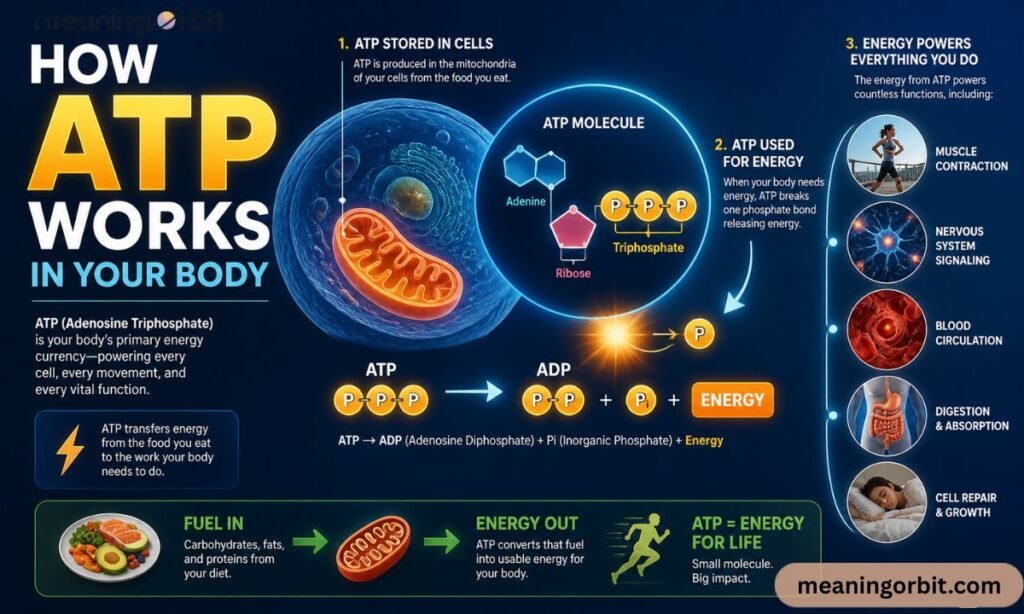
Your body produces ATP mainly through a process called cellular respiration. This happens inside tiny structures in your cells called mitochondria, which is why they are famously nicknamed the powerhouse of the cell. That nickname is actually earned.
Here is how the energy cycle works in plain terms:
You eat food (carbohydrates, fats, proteins).
Your body breaks that food down into glucose.
Glucose enters the mitochondria and goes through a process that produces ATP.
Your cells use ATP to power every function, from muscle movement to brain activity.
The leftover ADP gets recycled back into ATP using more food energy.
Your body produces and uses roughly its own weight in ATP every single day. That is not a typo. You are constantly regenerating it, which is why eating and breathing matter so much at the cellular level.
ATP in Sports and Exercise: Why Athletes Care So Much
If you have ever done an intense workout and felt that sudden drop in energy, you have experienced your ATP stores running low. Your muscles run on ATP, and during high-intensity exercise, you burn through it faster than your body can remake it.
This is why creatine is such a popular sports supplement. It helps your body regenerate ATP faster during short bursts of intense activity like sprinting or weightlifting. More ATP availability means more power output before fatigue kicks in.
There are three energy systems your body uses to make ATP during exercise:
Phosphocreatine system: fastest, used for 0 to 10 seconds of max effort.
Glycolytic system: medium speed, used for 10 seconds to 2 minutes.
Aerobic system: slowest but most efficient, used for longer efforts.
Understanding ATP is basically understanding why your body performs the way it does under different conditions. Your coach probably wishes more athletes knew this.
ATP in Tennis: What It Means for the Sport
Outside of biology, the most recognized use of ATP is in professional tennis. The Association of Tennis Professionals was founded in 1972 and governs the men’s professional tennis circuit worldwide.
The ATP Tour organizes hundreds of tournaments each year, including the famous Masters 1000 events and the year-end ATP Finals. When you hear commentators say a player’s ATP ranking has improved, they are referring to his position in the world rankings managed by this organization.
So while your cells are busy making ATP to power your muscles, the ATP Tour is busy ranking the world’s best players. Same letters, completely different worlds.
ATP Slang Meaning in Texting: The New Generation’s Definition
If you are a parent reading your teenager’s messages, you may have noticed ATP showing up with urgency. In modern texting slang, especially popular on platforms like TikTok and Snapchat, ATP most commonly stands for Answer The Phone.
It can also mean “at this point” in some contexts, used to express frustration or exasperation. For example, “ATP I give up” means “at this point, I am done trying.”
The slang usage grew organically from younger communities and has no connection to the scientific or sports meanings. Language evolves fast, and ATP evolved right along with it.
Common Mistakes People Make About ATP
There are a few widespread misconceptions about ATP that are worth clearing up directly.
Mistake 1: ATP is the same as energy. ATP is not energy itself. It is a molecule that stores and transfers energy. The energy comes from breaking the phosphate bond, not from ATP sitting there quietly.
Mistake 2: You store a lot of ATP. Your body only holds a small amount of ATP at any given time. It is constantly made and used in a rapid cycle, not stored in bulk like fat.
Mistake 3: Only mitochondria make ATP. Mitochondria are the main site, but the cell fluid (cytoplasm) also produces ATP through a process called glycolysis, even without oxygen.
Mistake 4: ATP works alone. ATP works together with enzymes, coenzymes, and various cellular processes. It is part of a highly coordinated system, not a lone ranger.
Which ATP Meaning Should You Use? A Quick Guide
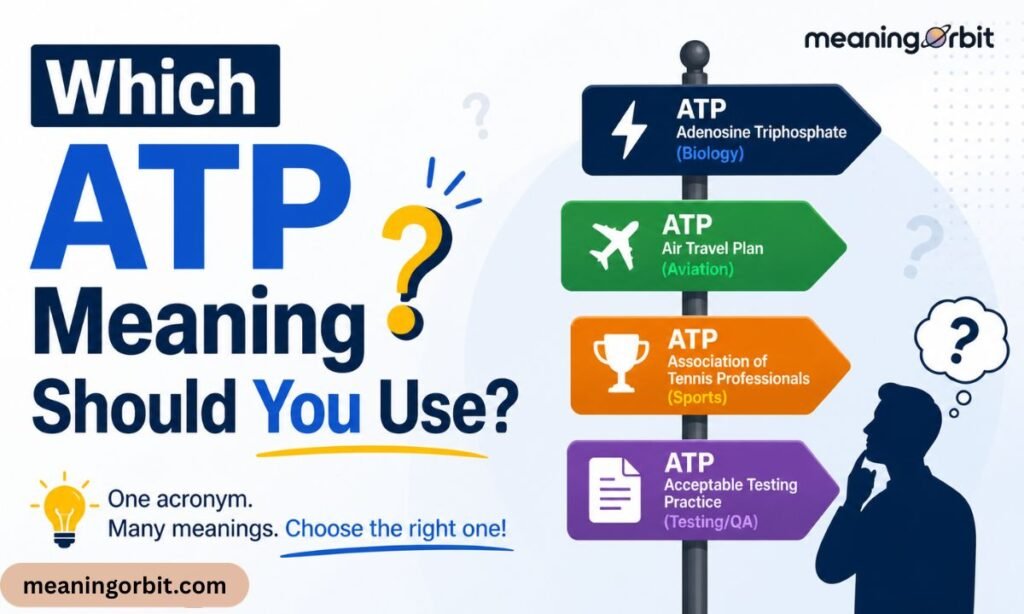
Since ATP carries multiple meanings depending on where you are, here is a fast reference to make sure you never use the wrong one in the wrong room.
In a biology class or health discussion: always use Adenosine Triphosphate.
In a sports or tennis conversation: use Association of Tennis Professionals.
In a text message from a younger person: probably Answer The Phone or At This Point.
In a financial or trading context: use At The Price.
In aviation: use Airline Transport Pilot.
The meaning does not change based on who says it smartest. It changes based on where the conversation is happening. Reading the room applies to acronyms too.
Biblical and Philosophical Angle: Energy, Life, and Purpose
Interestingly, the concept behind ATP connects to something much older than modern science. Many religious and philosophical traditions have long described life as being animated by an invisible force or energy.
In the Bible, Genesis 2:7 describes God breathing life into Adam: “the LORD God formed a man from the dust of the ground and breathed into his nostrils the breath of life.” Modern biology shows that this “breath of life” operates through oxygen-dependent processes that directly fuel ATP production. Without oxygen, aerobic ATP synthesis stops, and life as we know it cannot continue.
Whether you approach it spiritually or scientifically, the idea that life depends on an invisible, constantly renewing source of energy is a surprisingly universal concept. ATP is just the molecular name for part of that story.
Real-Life Examples of ATP in Action
Sometimes abstract molecules make more sense when you tie them to real moments.
Lifting weights: every rep burns ATP in your muscle fibers. The soreness next day is partly your cells rebuilding ATP and repairing tissue.
Thinking hard: your brain consumes about 20% of your body’s total ATP even though it is only 2% of your weight. Big ideas are expensive.
Sleeping: your cells continue producing ATP at night for repair processes. Sleep deprivation literally starves your cells of recovery time.
Eating sugar: glucose from food is the primary raw material for ATP production. This is why a quick snack can give you a real energy boost, not just a psychological one.
ATP is not an abstract science concept. It is the reason you can read this sentence right now.
Frequently Asked Questions
What does ATP stand for in simple terms?
ATP stands for Adenosine Triphosphate in biology. It is the molecule your body uses to store and release energy at the cellular level. In texting slang, it can mean Answer The Phone or At This Point. In sports, it refers to the Association of Tennis Professionals.
Why is ATP called the energy currency of the cell?
Just like money is used to pay for different things in the economy, ATP is used to pay for different biological processes inside your cells. Whether your cell needs to contract a muscle or build a protein, it spends ATP to get it done. The term energy currency was coined because of how universally and flexibly it is used across all cellular functions.
Can your body run out of ATP?
Your body cannot store large reserves of ATP, so in theory, yes. But in practice, your cells regenerate it so quickly that it almost never runs to zero under normal conditions. During extreme, prolonged exertion without fuel (food or oxygen), cells can become critically low on ATP, which is what causes organ failure in severe cases of starvation or cardiac arrest.
Conclusion
Whether you are a student preparing for a biology exam, a fitness enthusiast trying to understand your energy levels, a tennis fan following world rankings, or just someone wondering what that text message means, ATP has a clear, useful answer in each context.
The science version, Adenosine Triphosphate, is arguably one of the most important molecules ever discovered. It is the engine running quietly behind every living thing on the planet. The other versions, whether in sports, slang, or finance, have earned their place too.

William is a dedicated writer in the meaning niche with 4 years of experience, helping readers understand the true meanings of words and ideas in a simple way.His goal is to make understanding meanings simple, useful, and engaging for everyone.

2 thoughts on “ATP Meaning: The Simple, Clear Answer You Actually Need”