

You search for DPMO mean, and Google throws a wall of Six Sigma jargon at you. Formulas, Greek letters, and manufacturing lingo that make you feel like you accidentally enrolled in an engineering degree. Relax.
By the time you finish this article, you will know exactly what DPMO means, how it works, why it matters, and how to use it without breaking a sweat.
What Does DPMO Mean? (The Short Answer First)
DPMO stands for Defects Per Million Opportunities. It tells you how many defects would appear in one million chances for a defect to occur. Think of it as a quality scorecard. The lower the number, the better your process is performing. A DPMO of zero means perfection. A DPMO of one million means everything went wrong. Most real-world processes live somewhere in between.
If you want one sentence for your next meeting: DPMO is a standardized measure of process quality that counts defects out of every one million opportunities.
Where Did DPMO Come From? A Quick History
DPMO did not appear out of thin air. It grew out of the Six Sigma methodology, a quality management system developed by engineer Bill Smith at Motorola in the 1980s. Motorola was losing ground to Japanese competitors who were producing electronics with far fewer defects. Smith needed a way to measure quality at scale, and simple defect percentages were not precise enough.
The problem with percentages is that 0.01% sounds tiny until you realize it means 100,000 defects per billion. DPMO solved that by creating a common language precise enough to compare vastly different processes side by side. General Electric then popularized Six Sigma in the 1990s under Jack Welch, bringing DPMO into boardrooms worldwide.
So yes, this concept has a real origin story and decades of industrial muscle behind it.
How to Calculate DPMO: The Formula Made Simple
Here is the DPMO formula:
DPMO = (Number of Defects / (Number of Units × Opportunities per Unit)) × 1,000,000
Let us walk through a real example so it actually sticks.
Imagine a bakery produces 500 cakes. Each cake has 5 opportunities for a defect (wrong size, burnt edges, missing icing, incorrect flavor, poor packaging). The bakery finds 10 defects total.
Step 1: Multiply units by opportunities: 500 × 5 = 2,500 total opportunities
Step 2: Divide defects by total opportunities: 10 / 2,500 = 0.004
Step 3: Multiply by one million: 0.004 × 1,000,000 = DPMO of 4,000
That means if this bakery produced at this rate for one million opportunities, it would generate 4,000 defective cakes. Not terrible, but there is clearly room to improve. Nobody wants a sad, burnt birthday cake.
DPMO and Sigma Levels: What Is the Connection?
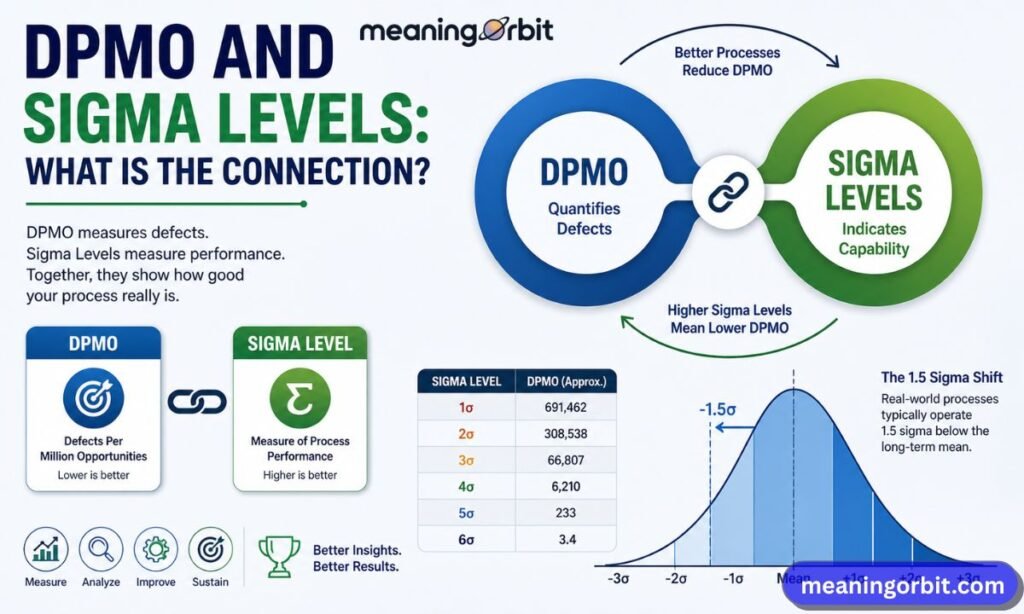
This is where things get genuinely interesting. DPMO connects directly to Sigma levels, which are quality benchmarks named after the Greek letter sigma (σ).
Here is a quick reference table so you can see how they relate:
| Sigma Level | DPMO | Quality Rate |
| 1 Sigma | 691,462 | 30.9% |
| 2 Sigma | 308,538 | 69.1% |
| 3 Sigma | 66,807 | 93.3% |
| 4 Sigma | 6,210 | 99.4% |
| 5 Sigma | 233 | 99.977% |
| 6 Sigma | 3.4 | 99.9997% |
The famous Six Sigma standard means only 3.4 defects per million opportunities. That is the gold standard of quality. To put that in human terms, if a surgeon performed one million operations at Six Sigma quality, fewer than four patients would experience a procedural error. That level of precision matters enormously when lives are at stake.
Real-Life Examples of DPMO in Action
DPMO is not just for factories and engineers. It shows up in places you interact with every day.
Airlines use DPMO to track lost luggage. If an airline handles 500,000 bags and loses 20, that works out to a DPMO of 40. A competitor with 5 lost bags per 500,000 has a DPMO of 10 and clearly runs a tighter operation.
Call centers measure DPMO by tracking how many customer calls result in an unresolved issue. Each call is a unit, and each failure point in resolution is an opportunity.
Software development teams calculate DPMO based on bugs found in production. Each feature is a unit, each potential failure point is an opportunity, and each reported bug is a defect.
Healthcare uses DPMO to measure medication errors, missed diagnoses, and incorrect procedures. When you hear that hospitals aim for Six Sigma quality in surgical prep, this is the number they are chasing.
DPMO vs. DPU vs. DPO: What Is the Difference?
These three acronyms trip people up constantly. Here is how they differ:
DPU (Defects Per Unit) counts how many defects exist across all units produced. If you make 100 products and find 25 defects, your DPU is 0.25. It does not account for how many opportunities existed per unit.
DPO (Defects Per Opportunity) is the ratio of defects to total opportunities. It is simply DPMO without the multiplication by one million. A DPO of 0.004 equals a DPMO of 4,000.
DPMO is the most useful for comparison because it is normalized to one million. You can compare a bakery to a car factory using DPMO, but comparing raw defect counts makes no sense.
In short: use DPMO when you want to compare quality across different processes, products, or industries. Use DPU when you just need a quick internal quality snapshot.
Which Metric Should You Actually Use?
If you are running a small internal quality check and your team understands your product well, DPU is fast and practical.
If you are benchmarking against competitors, presenting to leadership, or working across departments with different process complexities, DPMO is the right choice every time. It speaks a universal quality language.
If you are pursuing Six Sigma certification or implementing a formal quality management program, you will need DPMO because it is the standard currency of that entire methodology.
Think of it this way: DPU is like measuring temperature in your kitchen, while DPMO is the thermometer that works in kitchens worldwide and means the same thing everywhere.
Common Mistakes People Make with DPMO
Even experienced quality teams make these errors. Knowing them in advance saves you a lot of recalculation later.
Misdefining “opportunities.”
This is the biggest trap. Opportunities must be independent, meaningful chances for a defect to occur. Inflating opportunities artificially makes your DPMO look better than it is. If you manufacture a bolt, the opportunity count is not infinite just because theoretically anything could go wrong.
Confusing defects with defective units.
A single unit can have multiple defects. DPMO counts individual defects, not defective items. A cake with three problems counts as three defects, not one defective cake.
Applying DPMO to non-comparable processes.
Comparing a surgical ward to a software team using DPMO is only valid if you are measuring the same type of output characteristic and defining opportunities consistently.
Ignoring the baseline assumption.
DPMO calculations assume your process is centered. If your process is shifted (which it often is in reality), statisticians add a 1.5 sigma shift correction. The 3.4 DPMO for Six Sigma already includes this shift.
Does DPMO Have Any Historical or Philosophical Roots?

This might surprise you, but the drive to eliminate defects connects to something deeply human.
The ancient Romans had a quality concept called opus signinum, where tile layers were judged by how consistently they could produce uniform flooring. Japanese artisans developed kaizen (continuous improvement) centuries before Six Sigma formalized it. The pursuit of perfection, of reducing error to near zero, appears across cultures and time periods.
In the Bible, Proverbs 11:1 states: “A false balance is an abomination to the Lord, but a just weight is his delight.” Merchants who used accurate weights were considered righteous. The underlying principle, that precision and integrity in measurement reflect deeper values, is as old as civilization itself.
How to Improve Your DPMO Score
Identify the biggest opportunity sources.
Where are defect clustering? Use a Pareto chart (the 80/20 rule) to find the 20% of causes creating 80% of your defects.
Reduce process variation.
Most defects come from inconsistency, not bad intentions. Standardize procedures, create clear checklists, and reduce the number of manual handoffs.
Measure continuously, not occasionally.
A quarterly DPMO review is too slow. High-performing organizations track DPMO in near real-time so they catch drift early.
Train people, not just machines.
Human error causes a significant percentage of defects even in automated systems. Clear training reduces misunderstanding, which reduces defects.
Set realistic sigma targets.
Not every process needs Six Sigma quality. A 4 Sigma standard (DPMO of 6,210) is often good enough for low-risk processes, while medical and aerospace applications genuinely need to push toward 6 Sigma.
DPMO in the Age of AI and Automation
Here is something competitors rarely mention: DPMO is becoming more relevant, not less, in the age of automation.
When AI systems make decisions at scale, errors multiply fast. A machine learning model that misclassifies customer intent with a 1% error rate sounds harmless. At one billion transactions per year, that is ten million errors. In DPMO terms, that is 10,000 errors per million. Most companies would not tolerate that from a human team, yet they deploy AI systems with far less scrutiny.
Applying DPMO thinking to AI output quality is one of the fastest-growing applications of this classic metric. It gives data science teams and quality engineers a shared language for measuring model reliability, which is something the industry genuinely needs.
Frequently Asked Questions
Is a lower DPMO always better?
Yes, a lower DPMO means fewer defects, which means higher quality. Zero is theoretically perfect, though nearly impossible in practice. The goal is continuous reduction.
What is a “good” DPMO for most businesses?
It depends on the industry. General manufacturing typically targets 3 Sigma or better, which means a DPMO below 66,807. Healthcare and aerospace shoot for 5 to 6 Sigma. For most service businesses, a DPMO below 10,000 is considered strong performance.
Can DPMO be used for service industries, not just manufacturing?
Absolutely. DPMO applies to any process where you can define a unit, count opportunities, and identify defects. Customer service teams, software developers, logistics companies, and hospitals all use it effectively.
Conclusion
DPMO is one of the most powerful and underused quality tools available to any organization. It takes the messy, complicated reality of defects and turns them into a single, comparable number. It does not matter whether you are running a restaurant, a software team, or a hospital. If you can count defects and define opportunities, DPMO gives you a clear and honest picture of where you stand.
Start with your current process, calculate your DPMO, set a target sigma level, and build toward it one improvement at a time. The math is simple. The discipline is hard. But the results, fewer defects, happier customers, and stronger operations, are absolutely worth it.

William is a dedicated writer in the meaning niche with 4 years of experience, helping readers understand the true meanings of words and ideas in a simple way.His goal is to make understanding meanings simple, useful, and engaging for everyone.
