

You see it in a caption. You spot it in a comment. Someone sends it to you at 11 PM and you have absolutely no idea what just happened.
Sound familiar? IDGAF is one of those abbreviations that floats around the internet like it owns the place — and honestly, it kind of does. If you have ever stared at your screen wondering what it means, you are in the right place.
What Does “IDGAF” Mean in Text?
IDGAF stands for “I Don’t Give A F**k.” It is a bold, unfiltered way of saying that someone simply does not care — about an opinion, a situation, a consequence, or just life in general. When someone sends you IDGAF in a text, they are making it very clear that whatever you just mentioned has zero weight on their mind. None. Zip. The emotional equivalent of a shrug but with a lot more attitude.
It falls into the category of internet slang and text abbreviations that have taken over digital communication since the early 2000s.
Breaking Down Each Letter So There Is No Confusion
Let us make this crystal clear:
- I = I
- D = Don’t
- G = Give
- A = A
- F = F**k
Put it together and you get a phrase that communicates complete emotional detachment. It is blunt, it is direct, and it leaves absolutely no room for misinterpretation. That is actually one reason it became so popular online — it says in five letters what might take a full sentence to explain.
Where Did IDGAF Come From? A Quick Origin Story
IDGAF did not just appear out of thin air. It grew out of internet culture in the early 2000s, when SMS texting made short abbreviations incredibly practical. Nobody wanted to type full sentences on a numeric keypad, so phrases like LOL, BRB, and eventually IDGAF became digital shorthand.
The phrase itself, “I don’t give a f**k,” has deep roots in everyday English slang going back decades. Writers, musicians, and rebellious spirits have used variations of it throughout the 20th century to express bold indifference. Once texting and social media exploded, it got compressed into the five-letter abbreviation we know today.
Interestingly, the concept of radical indifference to external judgment is not entirely modern. Even the Stoic philosophers of ancient Greece preached the idea of releasing attachment to things outside your control. Marcus Aurelius never texted IDGAF, but if he did, it probably would have fit right into his journal.
How Is IDGAF Actually Used in Everyday Texting?
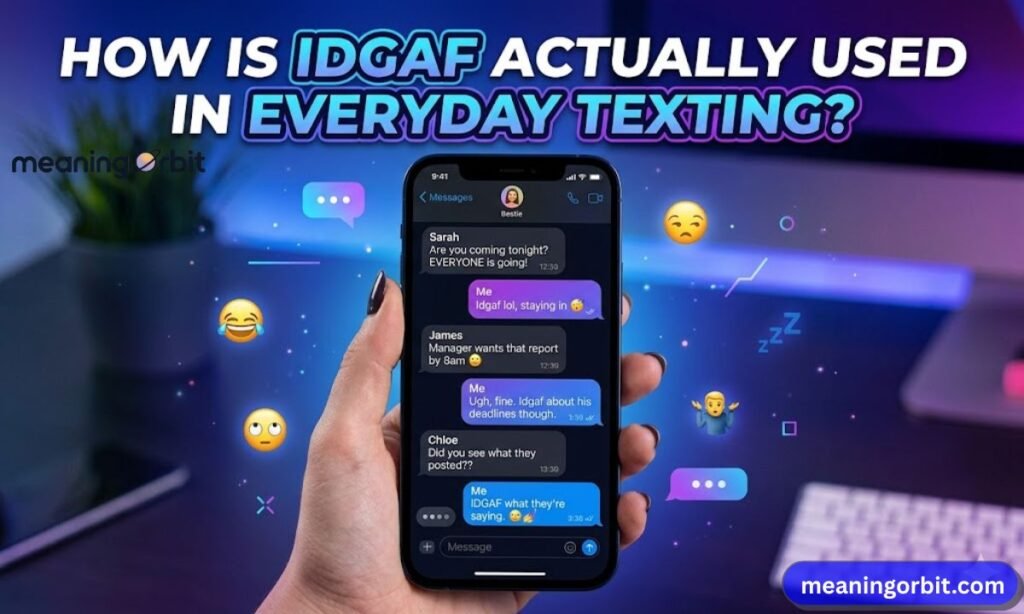
This is where things get practical. IDGAF shows up in a few different ways depending on the tone and context of the conversation. Here is what that looks like in real life:
Example 1 — Expressing personal freedom:
“People keep saying my outfit is too loud.” “IDGAF, you look amazing.”
Example 2 — Shutting down drama:
“Did you hear what they said about you?” “IDGAF honestly. Not my problem.”
Example 3 — Owning a decision:
“You really quit your job just like that?” “IDGAF, it was not making me happy.”
Example 4 — Social media captions:
A photo of someone doing something unexpected, captioned: “Living my best life, IDGAF era officially unlocked.”
You will notice it almost always carries a tone of confidence or emotional release. It is rarely passive. When someone types IDGAF, they are actively choosing not to let something affect them.
IDGAF vs. Similar Abbreviations: Quick Comparison Table
Not all indifference abbreviations are created equal. Here is how IDGAF compares to its close relatives:
| Abbreviation | Full Form | Tone | Best Used When |
| IDGAF | I Don’t Give A F**k | Bold, unapologetic | Strong emotional detachment |
| IDC | I Don’t Care | Mild, casual | Light indifference |
| DGAF | Don’t Give A F**k | Same as IDGAF, slightly shorter | Captions, statements |
| Meh | (no acronym) | Bored, underwhelmed | Low energy situations |
| Whatever | (no acronym) | Dismissive, sometimes passive-aggressive | Mild frustration |
Is IDGAF Positive, Negative, or Both?
This is one of the most overlooked aspects of the phrase. IDGAF is not always negative. In fact, it has taken on a surprisingly empowering meaning in modern culture.
On one hand, it can come across as rude or dismissive — especially if someone uses it to shut down a genuine concern or hurt someone’s feelings. Context matters enormously here.
On the other hand, many people use IDGAF as a statement of self-liberation. Pop culture has embraced it as an anthem for those who refuse to let other people’s opinions control their lives. When someone says they are in their “IDGAF era,” they usually mean they have stopped seeking external validation and started making choices purely for themselves. That is actually a healthy psychological shift.
When Is It Appropriate to Use IDGAF?
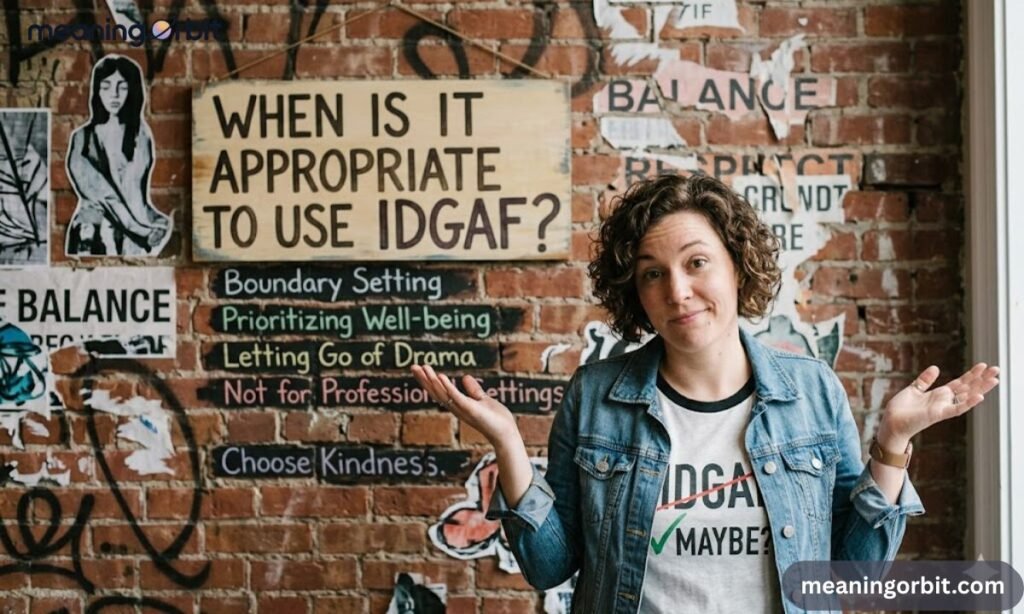
Let us be honest — IDGAF has a time and a place. It works perfectly in casual conversations with close friends, in creative captions, or in moments where you want to communicate genuine confidence. It does not belong in a work email. It probably should not appear in a message to your grandmother. And it will definitely raise some eyebrows in a formal group chat.
Here is a simple rule: if you would not say the full phrase out loud in that setting, do not send the abbreviation either. The shortcut does not change the weight of the word.
Use it freely in:
- Personal texts with close friends
- Social media posts and captions
- Casual group chats with people your own age
- Creative writing or informal content
Avoid it in:
- Professional emails or messages
- Formal conversations
- Any situation where profanity would be inappropriate
Common Mistakes People Make With IDGAF
Mistake 1: Assuming it is always aggressive.
IDGAF can actually be quite calm and self-assured depending on context. Someone saying “honestly IDGAF, I’m just doing me” is not angry. They are at peace.
Mistake 2: Using DGAF and IDGAF interchangeably without knowing the difference.
They mean the same thing, but DGAF drops the “I” and reads more like a general statement. IDGAF is personal and first-person. Both work, but they carry slightly different energy.
Mistake 3: Sending it to the wrong person.
Auto-complete and copy-paste have caused more than a few regrettable moments. Always check who you are texting before you hit send with IDGAF.
Mistake 4: Thinking it only fits anger.
It fits confidence, humor, and even warmth when used right. “You’re wearing that? IDGAF, honestly you always pull it off” is supportive, not harsh.
IDGAF in Pop Culture: Why It Went Mainstream
IDGAF jumped from text messages to the broader culture in a big way. Bebe Rexha released a song literally titled “IDGAF” that became a massive hit, using the phrase as a breakup anthem about reclaiming emotional power. That kind of mainstream exposure introduced the term to audiences who had never seen it in a text message before.
Beyond music, the phrase became a staple of meme culture, motivational content, and self-help language. The idea of the “IDGAF mindset” — focusing on your own happiness without obsessing over what others think — became genuinely popular as a personal development concept. When a five-letter abbreviation starts appearing in lifestyle articles and psychology discussions, you know it has officially graduated from slang to cultural statement.
Which One Should You Use: IDGAF or IDC?
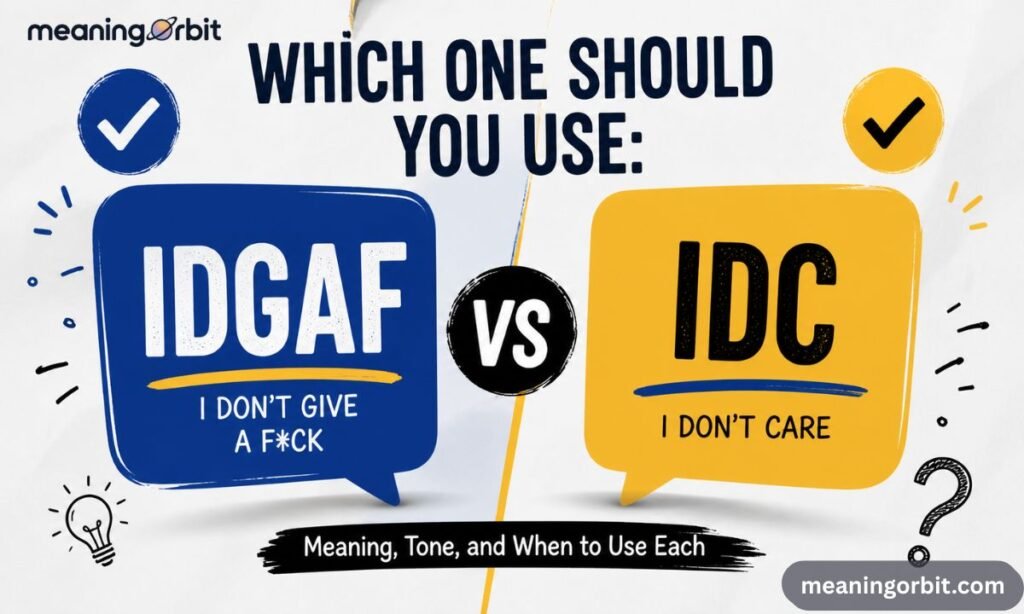
If you want to express mild indifference in a chill, no-drama way, go with IDC. It is softer, less intense, and works in more situations without raising eyebrows.
If you want to communicate strong, confident detachment — that you have genuinely made peace with something and moved on — IDGAF is the right call. Just make sure your audience is someone who will appreciate the bluntness and that the setting calls for it.
Think of it this way: IDC is a shrug. IDGAF is walking away from a burning building in slow motion without looking back.
A Quick Note on Tone in Digital Communication
One thing worth remembering with any strong abbreviation like IDGAF is that tone is invisible in text. What you mean as confident can read as aggressive. What you intend as funny can land as rude. Adding context — a follow-up sentence, an emoji, or a bit of warmth — can go a long way in making sure your message lands the way you actually meant it.
A simple “lol IDGAF, you know I love you” reads very differently from just “IDGAF” dropped into a serious conversation. Small additions carry big tonal weight in written communication.
Frequently Asked Questions
Is IDGAF considered rude?
It can be, depending on how and where you use it. In casual conversations with friends, it usually reads as confident or humorous. In formal settings or directed at someone who is genuinely upset, it can come across as dismissive and hurtful. Context is everything.
What is the difference between IDGAF and DGAF?
Both mean the same thing — “don’t give a f**k.” The difference is that IDGAF includes the “I” making it a personal, first-person statement. DGAF is slightly more general and is often used in captions or as a standalone attitude. Both are widely understood.
Can IDGAF be used in a positive way?
Absolutely. Many people use it as a statement of self-confidence and emotional freedom. Saying you are in your “IDGAF era” typically means you have stopped letting others control your choices and started living more authentically. In that context, it is genuinely empowering.
Conclusion
IDGAF means “I Don’t Give A F**k” — and that simple phrase carries a lot of emotional territory. It can signal confidence, indifference, freedom, or attitude depending entirely on how it is used and who is using it.
Now that you know exactly what it means, where it came from, how to use it, and what to watch out for, you are fully equipped to handle it whether it lands in your inbox or rolls off your own keyboard. Use it wisely, use it in the right setting, and when you do use it — mean it.

William is a dedicated writer in the meaning niche with 4 years of experience, helping readers understand the true meanings of words and ideas in a simple way.His goal is to make understanding meanings simple, useful, and engaging for everyone.
