

Have you ever received a text with “DTTM” and just stared at your phone like it owes you an explanation? You are not alone. This abbreviation quietly slipped into everyday digital conversations, and most people either guess wrong or panic-Google it.
So here it is, no drama: DTTM stands for “Don’t Text/Talk to Me.” It is a direct, no-nonsense signal that someone needs space, is busy, or simply does not want to be bothered right now. Simple, sharp, and surprisingly powerful for just four letters.
What Does DTTM Mean in Text?
When someone sends you DTTM in a text message, on social media, or in a chat, they are telling you clearly that they are unavailable or unwilling to communicate at that moment. It is the digital version of putting up a “Do Not Disturb” sign on your door, except far less polite and significantly more blunt.
The phrase covers two possibilities at once: texting and talking. This makes it flexible enough to use in both messaging and voice call contexts. Whether someone is swamped with work, emotionally overwhelmed, or simply done with a conversation, DTTM gets the point across fast.
Also read this : DTTM Meaning in Text: The Complete Guide You Actually Need
Where Did DTTM Come From?
Text abbreviations did not appear overnight. They grew out of necessity. In the early days of SMS messaging, people paid per character or per message. Shortening phrases was not laziness; it was economy. That habit stuck around long after unlimited texting became the norm.
DTTM emerged from the broader culture of internet slang, where speed and brevity are king. Platforms like Twitter (now X), Snapchat, and WhatsApp made short-form communication the default. DTTM fits perfectly into this world because it delivers a complete emotional message in four characters.
It belongs to the same family as BRB (Be Right Back), GTG (Got to Go), and IDC (I Don’t Care). All of these serve one purpose: communicate a feeling or need without writing a paragraph about it.
How Is DTTM Used in Real Conversations?
Understanding the meaning is one thing. Seeing how it actually appears in conversation is what makes it click. Here are a few real-life style examples:
Example 1: Avoiding drama
Friend: “Can we talk about what happened last night?” You: “DTTM right now, I need to cool off.”
Example 2: Being genuinely busy
Colleague: “Hey, are you free to hop on a call?” You: “DTTM, I’m in back-to-back meetings till 5.”
Example 3: Setting a boundary after an argument
Partner: “Can we figure this out?” You: “DTTM. I’ll reach out when I’m ready.”
Example 4: Used as a status or caption
Someone posts a story or status that simply reads: “DTTM today” Translation: Do not contact me at all today.
Notice how the tone shifts slightly depending on context. Sometimes it is firm. Sometimes it is practical. The word choice around DTTM shapes how it lands.
DTTM vs. Similar Abbreviations
People often mix up DTTM with similar-sounding abbreviations. Here is a clean breakdown so you never confuse them again.
| Abbreviation | Full Form | Tone | Best Used When |
| DTTM | Don’t Text/Talk to Me | Direct, firm | Needing space or silence |
| DND | Do Not Disturb | Neutral, polite | Busy or in focus mode |
| BRB | Be Right Back | Casual, temporary | Stepping away briefly |
| GTG | Got to Go | Friendly, quick | Ending a conversation |
| TTYL | Talk to You Later | Warm, open | Leaving on good terms |
| NGL | Not Gonna Lie | Honest, casual | Sharing opinions |
The key difference with DTTM is its emotional weight. While DND is neutral and BRB is friendly, DTTM carries a sense of urgency or irritation. It is not passive. It has an edge.
Does DTTM Always Mean Someone Is Angry?
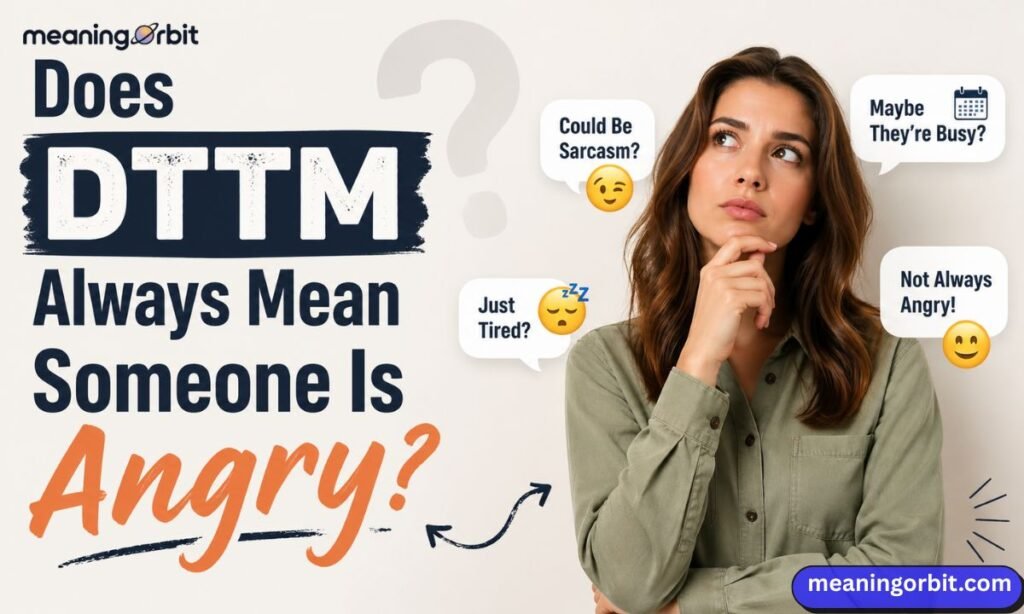
Not necessarily, and this is where a lot of people misread it. DTTM can signal anger, but it can also signal exhaustion, overwhelm, or focus. Context is everything.
If your friend sends “DTTM” after a heated argument, yes, they are probably upset. But if a coworker sends “DTTM for the next hour” during a deadline crunch, they are just protecting their focus. And if someone posts “DTTM today” on their Instagram story after a long week, they are really just asking the universe for one quiet day.
Reading the surrounding context, the relationship you have with the sender, and the tone of the conversation before it will tell you far more than the abbreviation itself.
Is There a Biblical or Historical Meaning to DTTM?
This one catches people off guard, but it is worth addressing. DTTM has no biblical or ancient historical origin. It is a purely modern, internet-age abbreviation. However, the concept behind it is ancient.
The idea of requesting silence and solitude goes back thousands of years. In the Bible, figures like Elijah, Moses, and Jesus repeatedly withdrew from people to find quiet and restoration. Elijah famously fled to the wilderness and asked to be left alone (1 Kings 19:4). Jesus often retreated to quiet places away from crowds. Even the Book of Psalms is filled with cries for space and stillness.
So while DTTM as a text abbreviation was born in the smartphone era, the human need it expresses is as old as civilization itself. People have always needed moments of quiet. We just now have a four-letter shorthand for it.
Common Mistakes People Make with DTTM
Knowing the meaning is only half the battle. Using it incorrectly can cause confusion or come across as ruder than you intend. Here are the most common mistakes:
Mistake 1: Using DTTM when you mean DND If you are simply busy and unavailable but still open to messages later, “DND” or “BRB” is softer and more accurate. DTTM implies a stronger emotional boundary.
Mistake 2: Sending DTTM without context A cold “DTTM” with no explanation can feel harsh or confusing to the recipient. Adding a brief reason (“DTTM, I’m in a meeting” or “DTTM right now, really stressed”) makes it far easier to understand and harder to misinterpret.
Mistake 3: Ignoring it when someone sends it to you This is the big one. If someone sends you a DTTM, respect it. Do not send follow-up messages asking “why?” or “are you okay?” Give them the space they are asking for. Pushing past that boundary almost always makes things worse.
Mistake 4: Confusing it with DTMF Some people mix up DTTM with DTMF, which stands for Dual-Tone Multi-Frequency, a technical term used in telecommunications for the sounds your phone keypad makes. These are completely different and exist in entirely separate contexts.
Which Abbreviation Should You Use?
If you are trying to communicate that you need space or quiet, here is a practical guide:
Use DTTM when:
- You are emotionally overwhelmed and need genuine distance
- You are frustrated and do not want a conversation to escalate
- You are posting a public status and want zero contact for a set period
Use DND when:
- You are in a meeting, working, or sleeping
- You want to appear professional and neutral
- The situation has no emotional charge to it
Use BRB or GTG when:
- You are stepping away temporarily
- The situation is light and casual
- You fully intend to reconnect soon
The right choice depends entirely on what you actually want to communicate. Tone matters in text even when you are trying to say nothing at all.
DTTM in Social Media Culture
Beyond personal texts, DTTM has found a strong home in social media. People drop it in captions, story statuses, and comment sections regularly. On platforms like TikTok and Instagram, it often appears as a self-care statement: a public declaration that someone is protecting their peace.
“DTTM today, healing in progress” has almost become a genre of its own.
This speaks to a larger cultural shift. Setting boundaries is increasingly seen as healthy rather than rude. Using DTTM in a status is a way of owning your emotional needs without owing anyone a detailed explanation. It is short, clear, and unapologetic, which is exactly what social media communication tends to reward.
Related Terms Worth Knowing
While you are getting familiar with DTTM, a few related abbreviations travel in the same circles and are worth adding to your digital vocabulary:
NMT (Not My Time): A softer way of saying you are unavailable without the emotional edge of DTTM.
LMK (Let Me Know): Often used after DTTM to signal that the silence is temporary. (“DTTM right now, LMK when you’re free later.”)
IRL (In Real Life): Used to separate digital interaction from face-to-face contact. Someone might say “DTTM but catch me IRL.”
HMU (Hit Me Up): The opposite of DTTM. Used to invite contact or reconnection.
These abbreviations often appear together in conversations, so understanding them as a group helps you read digital communication more accurately.
Why DTTM Matters More Than You Think
Here is something worth sitting with. The fact that DTTM exists and is widely used says something real about modern communication. We are more connected than ever, which means we are also more easily overwhelmed than ever. Notifications do not stop. Messages keep arriving. The expectation of instant response is constant.
DTTM is a boundary tool. It lets people communicate a need without writing an emotional essay at a moment when they may not have the capacity for one. In a world of endless digital noise, having a clear and understood signal for “I need quiet” is genuinely useful.
Using it respectfully and receiving it gracefully are both communication skills worth developing.
Frequently Asked Questions
Is DTTM rude to send?
It depends on how you use it. On its own with no context, it can feel abrupt. Adding a short reason or softening phrase makes it much easier to receive. Rude or not, it is always honest, and honesty in communication is rarely the wrong call.
Can DTTM be used professionally?
In most professional environments, it is better to stick with more neutral language like “I’m unavailable right now” or “DND until X time.” DTTM carries an emotional tone that may feel out of place in workplace communication, especially with people you do not know well.
What should I do if someone sends me DTTM?
Respect it. Do not send follow-up messages. Give them the space they asked for and wait for them to reconnect. If it was sent during an argument, resist the urge to get the last word. Space usually helps more than any response could.
Final Thoughts
DTTM in text is simply “Don’t Text/Talk to Me,” but the way it is used reveals a lot about the person sending it and the relationship they have with the person receiving it.
It can be a practical note about being busy, an emotional request for space, or a public declaration of self-care. The abbreviation is small, but the message behind it is big.

William is a dedicated writer in the meaning niche with 4 years of experience, helping readers understand the true meanings of words and ideas in a simple way.His goal is to make understanding meanings simple, useful, and engaging for everyone.
